

SEC Money Market Funds regulations play a critical role in safeguarding market stability and protecting investors in short-term fixed-income markets. Established and continuously updated by the U.S. Securities and Exchange Commission (SEC), these regulations govern how money market funds operate, manage liquidity, maintain credit quality, and respond to periods of market stress. In the aftermath of major financial disruptions—most notably the 2008 global financial crisis and the COVID-19 market shock—the SEC introduced stricter rules to enhance transparency, reduce systemic risk, and prevent fund runs. Explore the detailed article at Tipstrade.org to be more confident when making important trading decisions.
What Are SEC Money Market Funds Regulations?
The Role of the SEC in Regulating Money Market Funds
- The Securities and Exchange Commission (SEC) is the primary U.S. regulator responsible for overseeing money market funds. Its role is to protect investors, maintain fair and orderly markets, and reduce systemic risk within the financial system.
- Money market funds, while often perceived as cash-like instruments, are legally investment funds, not bank deposits. As such, they require oversight to prevent excessive risk-taking.
- From an investor perspective, SEC regulation exists to ensure that money market funds operate within strict risk limits, invest in high-quality short-term securities, and maintain sufficient liquidity to meet redemption demands.
- These safeguards are especially important because money market funds are widely used by corporations, municipalities, and individuals to manage short-term cash needs.
- Historically, the SEC’s involvement intensified after periods of financial stress revealed vulnerabilities in the money market fund industry.
- The agency’s regulatory framework aims to strike a balance between capital preservation, liquidity, and market efficiency, while avoiding the false perception that money market funds are risk-free bank accounts.

Overview of Rule 2a-7
At the heart of SEC Money Market Funds regulations lies Rule 2a-7 under the Investment Company Act of 1940. Rule 2a-7 defines what qualifies as a money market fund and sets out detailed requirements for portfolio maturity, credit quality, diversification, and liquidity.
Rule 2a-7 limits the weighted average maturity (WAM) and weighted average life (WAL) of a fund’s portfolio to reduce interest rate and credit risk. It also restricts investments to securities that meet strict credit quality standards, often referred to as “eligible securities.” These measures are designed to ensure that money market funds remain resilient during periods of market volatility.
For investors, Rule 2a-7 acts as a safety framework. While it does not eliminate risk entirely, it significantly reduces the likelihood of severe losses. Understanding this rule helps investors evaluate the trade-offs between yield, liquidity, and safety when choosing different types of money market funds.
Why Did the SEC Introduce Money Market Fund Reforms?

Lessons from the 2008 Financial Crisis
The global financial crisis of 2008 was a turning point for money market fund regulation. A major event occurred when the Reserve Primary Fund “broke the buck,” meaning its net asset value fell below $1 per share after exposure to Lehman Brothers’ debt. This shattered the long-held assumption that money market funds were inherently safe.
From an experience-based perspective, many investors at the time treated money market funds as cash equivalents, unaware of the underlying credit exposure. When panic spread, massive redemptions followed, threatening broader financial stability. The SEC responded by strengthening oversight to prevent similar events in the future.
These reforms aimed to reduce the risk of investor runs, improve transparency, and ensure that funds held sufficient liquidity to meet redemption demands. The 2008 crisis demonstrated that even conservative investment vehicles could pose systemic risks if left inadequately regulated.
Market Stress Events: 2020 and Beyond
Another critical stress test occurred in March 2020, during the onset of the COVID-19 pandemic. Financial markets experienced a sudden liquidity shock, and investors rushed to convert assets into cash. Prime money market funds, in particular, faced significant redemption pressure.
Although the Federal Reserve intervened to stabilize markets, the episode revealed ongoing vulnerabilities. SEC analysis concluded that existing rules needed refinement to better handle extreme market stress without relying on emergency government support.
As a result, the SEC introduced further amendments aimed at strengthening liquidity management and reducing the likelihood of forced asset sales. These changes reflect a regulatory philosophy focused on prevention rather than rescue, reinforcing investor confidence in money market funds during uncertain times.
Key SEC Rules Governing Money Market Funds
Portfolio Maturity and Credit Quality Requirements
One of the most important aspects of SEC Money Market Funds regulations is the limitation on portfolio maturity. Rule 2a-7 requires funds to maintain a weighted average maturity (WAM) of no more than 60 days and a weighted average life (WAL) of no more than 120 days. These limits reduce exposure to interest rate fluctuations.
In addition to maturity constraints, funds must invest in high-quality, short-term debt instruments. Securities must meet strict credit standards, often involving top-tier ratings or equivalent internal assessments. This minimizes default risk and enhances overall portfolio stability.
For investors, these requirements mean that money market funds are designed to remain relatively stable even when interest rates change rapidly. However, they also limit potential returns, reinforcing the trade-off between safety and yield inherent in these products.
Liquidity Requirements
Liquidity is a cornerstone of SEC regulation. Money market funds must maintain minimum levels of daily liquid assets and weekly liquid assets. These assets include cash, U.S. Treasury securities, and other highly liquid instruments.
The purpose of these requirements is to ensure that funds can meet redemption requests without selling less liquid assets at unfavorable prices. During periods of market stress, this liquidity buffer acts as a shock absorber.
From an investor’s point of view, liquidity requirements provide reassurance that money market funds can handle sudden cash needs. However, maintaining high liquidity can also reduce yield, as the most liquid assets typically offer lower returns.
Net Asset Value (NAV) Rules
The SEC distinguishes between stable NAV and floating NAV money market funds. Retail and government money market funds are generally allowed to maintain a stable NAV of $1 per share, while institutional prime and municipal funds must use a floating NAV.
This distinction reflects differing risk profiles. Floating NAV funds provide greater transparency by reflecting small changes in market value, helping investors better understand underlying risks.
For institutional investors, floating NAVs encourage more disciplined cash management. Retail investors, on the other hand, benefit from the simplicity of stable NAV funds, which align more closely with everyday cash management needs.
Liquidity Fees and Redemption Gates Explained
What Are Liquidity Fees?
Liquidity fees are charges imposed on investors who redeem shares during periods of stress, when a fund’s liquidity falls below regulatory thresholds. The SEC introduced these fees to discourage rapid withdrawals that could destabilize a fund.
From a practical perspective, liquidity fees help ensure fairness by allocating the cost of liquidity to those who demand it during stressed conditions. This mechanism reduces the incentive for “first movers” to rush for the exit.
For investors, understanding liquidity fees is critical. While they are rarely applied, their existence underscores the importance of viewing money market funds as investment products, not guaranteed cash substitutes.
What Are Redemption Gates?
Redemption gates allow a fund to temporarily suspend redemptions when liquidity falls below certain levels. The goal is to prevent panic-driven runs that could harm remaining investors.
Although controversial, redemption gates are designed as a last resort. They provide fund managers time to restore liquidity without selling assets at distressed prices.
From an investor trust standpoint, transparency around redemption gates is essential. The SEC requires clear disclosure so investors understand under what conditions access to funds could be restricted.
Types of Money Market Funds Under SEC Rules
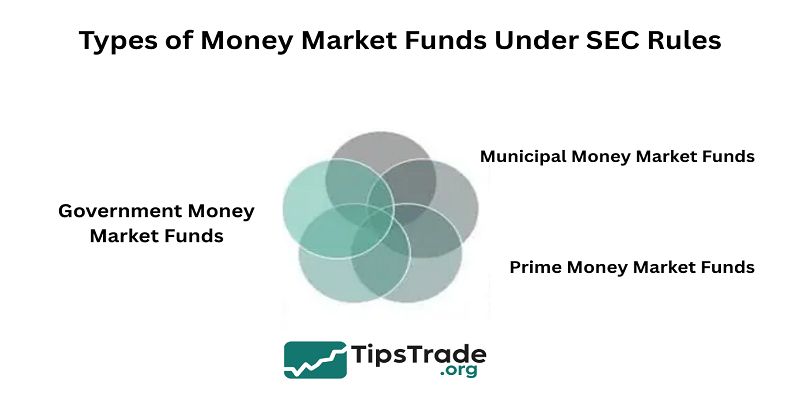
Government Money Market Funds
- Government money market funds invest primarily in U.S. Treasury securities, government agency debt, and repurchase agreements backed by government securities.
- These funds are considered the safest category under SEC rules.
- They are exempt from certain requirements, such as liquidity fees and redemption gates, making them especially attractive to risk-averse investors.
- Yields may be slightly lower, but safety and simplicity are key advantages.
Prime Money Market Funds
- Prime money market funds invest in a broader range of instruments, including high-quality corporate commercial paper. This allows for potentially higher yields but introduces additional credit risk.
- SEC regulations impose stricter rules on prime funds, including floating NAVs for institutional investors and the possibility of liquidity fees. These measures aim to balance yield potential with systemic stability.
Municipal Money Market Funds
- Municipal money market funds invest in short-term debt issued by state and local governments.
- Their primary appeal lies in tax advantages, as income may be exempt from federal, state, or local taxes.
- SEC rules ensure that these funds meet the same liquidity and quality standards as other money market funds, while offering tax-efficient income for eligible investors.
How SEC Regulations Affect Investors
Impact on Retail Investors
For retail investors, SEC regulations provide a framework of confidence and transparency. Stable NAV options, strong liquidity standards, and enhanced disclosures make money market funds easier to understand and use responsibly.
However, investors should not confuse regulation with guarantees. Understanding fund type, risk profile, and applicable rules is essential for aligning expectations with reality.
Impact on Institutional Investors
Institutional investors face a more complex environment. Floating NAVs and liquidity management requirements require more active cash planning. While these rules enhance system stability, they also demand greater operational sophistication.
Many institutions now use a combination of government money market funds and Treasury securities to manage liquidity more effectively under the regulatory framework.
Pros and Cons of SEC Money Market Fund Regulations

Benefits
- Enhanced investor protection
- Reduced systemic risk
- Greater transparency
Limitations
- Potentially lower yields
- Increased complexity
- Reduced flexibility during stress
Conclusion
SEC Money Market Funds regulations are essential to maintaining confidence, resilience, and orderly functioning within the U.S. money markets. By enforcing requirements on liquidity thresholds, portfolio quality, stress testing, and disclosure, the SEC has significantly strengthened the ability of money market funds to withstand periods of volatility without jeopardizing investor capital. While regulatory changes may limit yield flexibility or impose operational constraints on fund managers, they ultimately serve the broader goal of financial stability and investor protection. In an environment of shifting interest rates and recurring market uncertainty, SEC regulations remain a cornerstone for ensuring that money market funds continue to function as a reliable and low-risk investment vehicle.