
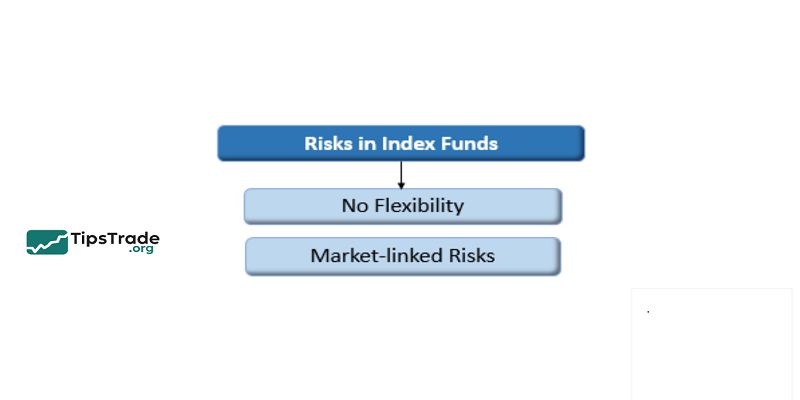
Risks in Index Funds, while often overshadowed by their low costs and simplicity, deserve careful scrutiny for any investor building a diversified portfolio. These passive vehicles track market indices like the S&P 500, offering broad exposure but exposing holders to systemic vulnerabilities such as market downturns, concentration in mega-cap stocks, and lack of adaptability during economic shifts. Explore the detailed article at Tipstrade.org to be more confident when making important trading decisions.
Market Risk in Index Funds
Market risk is the most fundamental risk associated with index funds. Because index funds are designed to track the market, they rise and fall with it.
Exposure to Market Downturns
Index funds provide full exposure to market declines. Unlike actively managed funds, index funds do not shift to cash, hedge positions, or avoid overvalued securities during downturns. When the market falls, index funds fall as well.
Historical examples clearly illustrate this risk:
- During the 2008 Global Financial Crisis, the S&P 500 fell by more than 50% from peak to trough.
- In March 2020, global equity indices dropped sharply during the COVID-19 market crash.
Investors holding broad market index funds experienced these losses in full. According to data from the Federal Reserve and Vanguard, investors who sold during these downturns often locked in losses, while those who stayed invested eventually recovered—but only after enduring significant volatility.
Volatility During Economic Cycles
- Market volatility is an unavoidable feature of index fund investing. Index funds amplify exposure to economic cycles because they mirror the collective behavior of the market.
- During expansions, this works in investors’ favor. During recessions, however, volatility can increase dramatically.
- Research from the CFA Institute shows that volatility spikes tend to trigger emotional decision-making, especially among newer investors.
- In real-world portfolio reviews, many investors underestimate how uncomfortable it feels to see a 20–30% decline on paper.
- This behavioral reaction, not the index fund itself, often becomes the biggest source of loss.
Lack of Flexibility and Active Risk Management
One of the defining features of index funds—passive management—is also a key source of risk.
No Downside Protection
Index funds offer no built-in downside protection. They do not:
- Reduce exposure during market bubbles
- Exit overvalued sectors
- Adjust allocations based on economic indicators
For example, during periods of extreme market optimism, index funds continue allocating capital based on index rules rather than valuation.
Research published by Morningstar highlights that passive funds remained fully invested in overvalued sectors prior to major corrections, such as the dot-com bubble.
This lack of flexibility means investors must rely entirely on their own asset allocation and risk tolerance to manage downside risk.
Inability to Avoid Overvalued Stocks
Most equity index funds use market-cap weighting, meaning the largest and most expensive companies receive the highest allocations.
This creates a structural risk:
- Stocks that rise rapidly gain more weight
- Overvalued companies can dominate the index
- Investors are forced to buy more of what has already gone up
Academic research from Robert Shiller and data from MSCI suggest that market-cap-weighted indices may increase exposure to valuation risk during bubbles. While this approach works well over long periods, it can lead to painful corrections.
Concentration Risks in Index Funds
Many investors believe index funds are fully diversified. In reality, diversification depends on index construction.
Market-Cap Weighting Issues
In popular indices like the S&P 500 or Nasdaq 100, a small number of companies can account for a large percentage of total returns.
For example:
- At various points, the top 5–10 stocks have represented over 25% of the S&P 500.
- Technology companies have dominated index performance in recent years.
According to S&P Dow Jones Indices research, this concentration increases vulnerability if leading companies underperform or face regulatory challenges.
Sector and Geographic Concentration
- Index funds may also suffer from sector or geographic concentration. A U.S. equity index fund is heavily exposed to the U.S. economy, monetary policy, and domestic regulation.
- Similarly, sector-specific index funds—such as technology or energy ETFs—can experience extreme volatility. Investors who mistakenly assume these funds offer broad diversification may face higher risk than expected.
Interest Rate and Inflation Risks
While equity index funds face market risk, bond index funds introduce different but equally important risks.
Rising Interest Rates Impact
- Bond prices move inversely to interest rates. When rates rise, bond index funds typically decline in value.
- This became evident during recent tightening cycles when central banks aggressively raised rates.
- Data from the Federal Reserve shows that many broad bond indices experienced negative returns—an outcome that surprised investors who assumed bonds always provide stability.
- Long-duration bond index funds are especially sensitive to rate changes, increasing potential losses during inflationary periods.
Inflation Eroding Real Returns
- Inflation risk is often overlooked in index fund discussions. While nominal returns may appear positive, real returns after inflation can be negative.
- Research from the Federal Reserve Bank highlights that fixed-income index funds struggle during high inflation environments unless yields rise significantly.
- Even equity index funds may fail to keep pace with inflation over shorter time horizons.
Tracking Error and Structural Risks
Index funds aim to track benchmarks, but they rarely match them perfectly.
Tracking Error Explained
Tracking error refers to the difference between a fund’s performance and its underlying index.
Common causes include:
- Expense ratios
- Trading costs
- Sampling methods
- Cash drag
According to Vanguard research, tracking error is usually small for large, low-cost funds, but it can increase during volatile markets or in less liquid asset classes.
Index Construction and Rebalancing Risks
Indices are not neutral. They follow specific rules that can influence returns.
For example:
- Rebalancing can force funds to buy high and sell low
- Index changes may introduce timing inefficiencies
- New inclusions can be overpriced due to demand from passive funds
Academic studies published by the Journal of Finance show that index reconstitution effects can temporarily distort prices.
Behavioral Risks for Investors
One of the most underestimated risks of index funds is investor behavior.
Panic Selling During Market Crashes
- Data from Morningstar consistently shows that investor returns often lag fund returns due to poor timing decisions.
- During market crashes, many investors sell index funds at or near market bottoms.
- In real portfolio reviews, long-term losses are often caused not by the index itself, but by emotional reactions to volatility.
Overconfidence in Passive Investing
Index funds are sometimes marketed as a “set it and forget it” solution. While simplicity is a strength, it can also lead to overconfidence.
Investors may:
- Ignore asset allocation
- Underestimate risk tolerance
- Fail to rebalance portfolios
According to behavioral finance research, this complacency increases long-term risk.
Regulatory and Systemic Risks
As index funds grow in popularity, concerns about systemic risk have increased.
Changes in Regulations
- Index funds and ETFs operate under regulatory frameworks that can change. New rules related to liquidity, disclosures, or market structure may affect fund operations and costs.
- Regulatory bodies such as the SEC and ESMA have already increased scrutiny of passive investing, particularly regarding market stability.
Systemic Risk Concerns
- Some economists argue that the dominance of index funds could amplify market stress.
- While research remains mixed, institutions like the Federal Reserve have acknowledged the need to monitor systemic effects.
- Although this risk is theoretical, it highlights the importance of understanding broader market dynamics.
How to Reduce Risks When Investing in Index Funds

Understanding risk is only part of the equation. Investors can take practical steps to reduce exposure.
Diversification Across Asset Classes
True diversification goes beyond owning one index fund. Combining:
- Domestic and international equities
- Bonds of varying durations
- Real assets or alternatives
Research from Vanguard shows that diversified portfolios experience lower volatility and more consistent long-term outcomes.
Long-Term Perspective and Rebalancing
- A disciplined, long-term approach is one of the most effective risk management tools. Regular rebalancing helps maintain target allocations and reduces behavioral mistakes.
- Historical data consistently supports staying invested through market cycles rather than attempting to time the market.
Conclusion
Risks of Index Funds underscore the need for balanced strategies rather than blind reliance on passive investing’s popularity. While they provide efficient market access, vulnerabilities like overvaluation in popular indices, regulatory changes, and black swan events can erode gains over time. Historical examples, including the dot-com bust and tech concentration in recent years, remind us that no investment is risk-free. Savvy investors counter these by diversifying across asset classes, maintaining cash reserves, and staying informed to protect long-term wealth.