
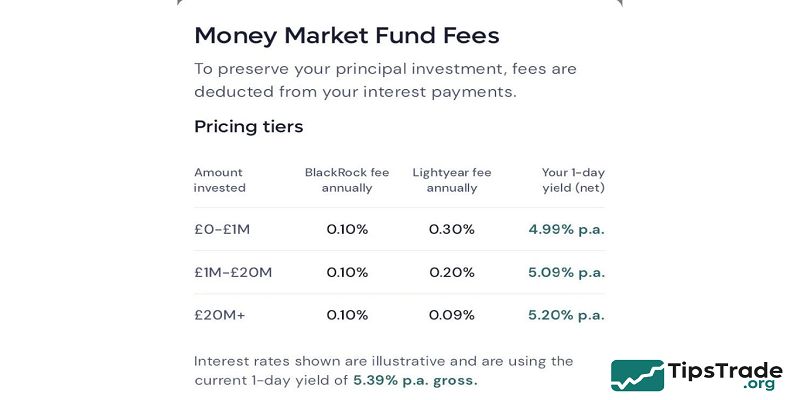
Money market fund fees are a critical but often overlooked factor when investors evaluate cash-equivalent investments, short-term liquidity solutions, and capital preservation strategies. Because money market funds typically generate modest returns, even small costs—such as expense ratios, management fees, or administrative expenses—can significantly affect net yield, income stability, and overall investment efficiency. For many investors researching money market fund fees, the key intent is clear: understanding what fees are charged, how they are calculated, and whether lower-cost funds actually deliver better outcomes. Explore the detailed article at Tipstrade.org to be more confident when making important trading decisions.
What Are Money Market Fund Fees?
Definition of Money Market Fund Fees
- Money market fund fees refer to the ongoing costs charged by a fund to operate and manage investor assets. Unlike transaction-based investments that charge commissions per trade, money market funds typically deduct fees continuously from fund assets.
- These costs are reflected in the fund’s expense ratio, which represents the annual percentage of assets used to cover operating expenses.
- From a third-person investor experience, many individuals assume that money market funds are “almost free” due to their conservative nature.
- However, even a small expense ratio—such as 0.20%—can meaningfully reduce returns when yields are low.
- Because money market funds focus on safety and liquidity rather than growth, fees play a disproportionately important role in determining net performance.
Why Fees Matter in Low-Yield Investments
- In higher-return asset classes, fees may be partially offset by capital appreciation. Money market funds, however, rely almost entirely on interest income, making them especially sensitive to costs.
- For example, if a money market fund generates a gross yield of 4.5% but charges a 0.35% expense ratio, the investor’s net yield drops to 4.15%. In a lower-rate environment, fees can consume an even larger share of returns, sometimes leaving investors with minimal real income.
How Fees Are Deducted from Fund Returns
- Money market fund fees are deducted daily, directly from fund assets. Investors never see a line-item charge on their account statement; instead, fees reduce the yield earned over time.
- This structure reinforces the importance of understanding fees before investing, rather than assuming returns are purely interest-driven.

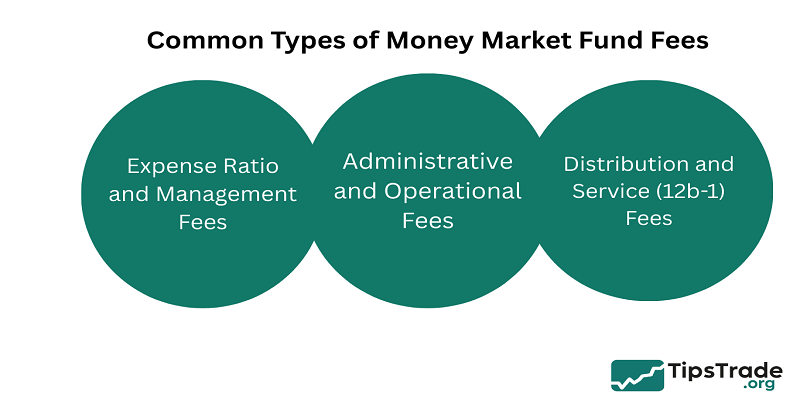
Common Types of Money Market Fund Fees
Expense Ratio and Management Fees
The expense ratio is the most important cost metric for money market funds. It includes:
- Portfolio management fees
- Custody and accounting costs
- Legal and compliance expenses
Management fees compensate the fund manager for selecting assets, monitoring credit quality, and maintaining liquidity. Although these fees are generally lower than those of actively managed bond or equity funds, they still have a measurable impact on returns.
Administrative and Operational Fees
- Administrative fees cover operational tasks such as recordkeeping, shareholder reporting, and customer service. While these costs may seem minor individually, they contribute to the total expense ratio.
- From a practical standpoint, large fund providers often benefit from economies of scale, allowing them to spread administrative costs across more assets and offer lower overall fees.
Distribution and Service (12b-1) Fees
- Some money market funds charge 12b-1 fees, which cover marketing and distribution expenses. These fees are more common in retail funds and less common in institutional share classes.
- Experienced investors often avoid funds with higher 12b-1 fees, especially when comparable low-cost alternatives exist.
How Expense Ratios Work in Money Market Funds
What Is Included in the Expense Ratio
The expense ratio aggregates all recurring operational costs into a single annual percentage. It does not include transaction costs within the portfolio, but it captures nearly all expenses directly affecting yield.
This metric allows investors to compare funds easily, but it must be interpreted in context—particularly during periods of fee waivers.
Typical Expense Ratio Ranges
Money market fund expense ratios typically fall into the following ranges:
| Fund Type | Typical Expense Ratio |
| Government MMFs | 0.05% – 0.25% |
| Prime MMFs | 0.15% – 0.45% |
| Institutional MMFs | Often below 0.15% |
Lower expense ratios generally translate into higher net yields, all else being equal.
Net Yield vs Gross Yield Explained
Gross yield reflects income generated before fees, while net yield reflects what investors actually earn.
Because marketing materials often emphasize gross yield, investors should always confirm the net yield after expenses.
Government vs Prime Money Market Fund Fees
Fee Structures in Government Money Market Funds
- Government money market funds typically charge lower fees due to simpler asset structures and lower credit analysis costs. Their heavy reliance on Treasury securities reduces operational complexity.
- As a result, these funds are often favored by conservative investors prioritizing cost efficiency.
Fee Structures in Prime Money Market Funds
- Prime money market funds generally charge higher fees because they invest in a wider range of corporate and bank-issued securities.
- Additional credit analysis and risk monitoring increase management costs.
Why Fee Differences Exist
- The difference in fees reflects risk management effort, asset complexity, and regulatory requirements.
- Higher fees are not necessarily unjustified, but they must be weighed against incremental yield.
How Fees Impact Short-Term and Long-Term Returns
Fee Impact in Low Interest Rate Environments
- During low-rate periods, fees can consume a majority of returns. Historically, some money market funds waived fees entirely to prevent negative yields.
- This illustrates how fee sensitivity increases as interest rates decline.
Real-World Examples of Fee Drag
Consider two funds with identical gross yields of 3.8%:
- Fund A charges 0.10%
- Fund B charges 0.40%
Over one year, Fund A delivers meaningfully higher net income, despite similar underlying assets.
When Higher Fees May Be Justified
- Higher fees may be justified if a fund offers superior liquidity management, credit discipline, or operational resilience.
Comparing Money Market Fund Fees Effectively
How to Read Fund Prospectuses and Fact Sheets
Key sections include:
- Total expense ratio
- Waived vs non-waived expenses
- Yield disclosures
Key Fee Metrics Investors Should Compare
- Expense ratio
- Presence of 12b-1 fees
- Fee waiver expiration dates
Common Mistakes Investors Make
- Common errors include focusing solely on yield, ignoring fee structures, and overlooking waiver terms.
Regulatory Oversight of Money Market Fund Fees
SEC Disclosure Requirements
- Regulators require clear disclosure of expense ratios and fee structures.
Transparency and Reporting Standards
- Monthly reporting improves investor visibility into fund costs.
Investor Protections Related to Fund Costs
- Regulatory oversight limits excessive fees and promotes competition.
Money Market Fund Fees vs Other Cash-Equivalent Costs
| Investment Type | Typical Fees |
| Money Market Funds | 0.05% – 0.45% |
| Savings Accounts | 0% |
| Treasury Bills | 0% (direct) |
This comparison highlights why fees deserve careful evaluation.
Conclusion
Money market fund fees may appear small, but their impact on net yield, income stability, and investment efficiency is substantial. Because these funds are designed for safety and liquidity rather than growth, understanding expense ratios, fee waivers, and cost structures is essential. Investors who evaluate fees carefully—rather than relying on headline yields—are better positioned to use money market funds effectively as part of a disciplined cash management strategy. Transparency, cost awareness, and realistic expectations remain the foundation of successful money market fund investing.