

How to join pension funds is one of the most important steps individuals can take to build long-term financial security. Pension funds play a critical role in retirement planning, long-term savings, income replacement, and wealth accumulation over time. Many people delay joining simply because they do not understand the eligibility requirements, contribution rules, or investment risks involved. This guide explains, step by step, how pension funds work, who can join them, and how to choose the right option based on real-world examples and expert research. Explore the detailed article at Tipstrade.org to be more confident when making important trading decisions
What Is a Pension Fund?
A pension fund is a long-term investment vehicle designed to provide individuals with a stable income during retirement. Instead of relying solely on personal savings or government support, participants contribute money regularly to a professionally managed fund.
These contributions are then invested in diversified assets such as stocks, bonds, real estate, and sometimes alternative investments. Over time, returns generated by these investments accumulate and are paid out when the participant reaches retirement age.
From an expert perspective, pension funds are considered one of the most efficient retirement tools because they pool capital and spread risk across many participants. According to research published by the World Bank and the OECD, pension funds contribute significantly to financial stability and long-term economic growth.
In real-world reviews of retirees, individuals who joined pension funds early often experience less financial stress and greater income predictability compared to those relying solely on savings accounts or family support. Understanding the basic structure of pension funds is essential before deciding how to join one.

See more
- Public Pension Funds Explained: How Government Retirement Systems Work
- Pension Funds Fees Explained: What You Pay and Why It Matters for Retirement
- Pension Funds Management: How Retirement Assets Are Managed for Long-Term Stability
- Defined Benefit Pension Funds: How Guaranteed Pension Plans Work and What They Mean for Retirement Security
How Pension Funds Work
At a fundamental level, pension funds operate through a simple but powerful cycle: contributions, investment, and payouts. Participants make regular contributions, either independently or with support from employers.
These contributions are pooled together and managed by professional fund managers who follow strict regulatory guidelines. The goal is to balance growth and risk to ensure long-term sustainability.
From an experience-based review, many workers underestimate the importance of compound growth. For example, someone who starts contributing at age 25 often contributes less overall but receives a higher retirement payout than someone who starts at 40.
This effect is supported by academic studies from financial institutions and retirement research centers. Pension funds are typically regulated by government authorities to protect participants, making them more trustworthy than informal savings schemes.
Understanding this operational model helps individuals appreciate why joining early and contributing consistently is so important.
Types of Pension Funds You Can Join

Government or State Pension Funds
Government pension funds are usually mandatory or semi-mandatory systems established to provide basic income security in retirement. These funds are funded through payroll taxes or social security contributions.
The primary advantage is stability, as they are backed by the state and regulated by law. However, benefits are often modest and may not fully cover living expenses.
From a third-person review perspective, retirees who rely solely on state pensions often report financial constraints, especially in countries with aging populations.
Research from the World Bank highlights that public pension systems face sustainability challenges, making them insufficient as a standalone retirement solution.
While government pension funds are an essential foundation, experts recommend complementing them with additional pension options.
Employer-Sponsored Pension Funds
Employer-sponsored pension funds are offered by companies as part of employee benefit packages. Contributions are often shared between employees and employers, with some companies offering matching contributions.
This effectively increases retirement savings without additional effort from the employee.
In many case studies, employees who fully utilize employer matching programs accumulate significantly higher retirement balances.
According to OECD data, employer-sponsored pensions are among the most efficient retirement savings mechanisms. However, these funds may have vesting periods and limited portability. Understanding company policies is crucial before joining, especially for workers who anticipate changing jobs.
Private and Individual Pension Funds
Private pension funds are voluntary and designed for individuals who want greater control over their retirement planning.
These are particularly popular among freelancers, self-employed professionals, and individuals without access to employer plans. Contributions are flexible, and investment strategies can often be customized.
From experience-based reviews, individuals value the flexibility of private pension funds but also face higher responsibility.
Market volatility directly affects returns, and fees can vary widely. Research from financial advisory firms emphasizes the importance of comparing costs and long-term performance before joining a private pension fund.
For disciplined investors, private pensions can significantly enhance retirement outcomes.
Who Is Eligible to Join a Pension Fund?

Employees
- Most employees are eligible to join pension funds through their employers or government systems.
- Eligibility typically depends on age, employment status, and income level.
- In many countries, full-time employees are automatically enrolled, while part-time workers may need to opt in.
- Reviews of workplace pension participation show that automatic enrollment dramatically increases participation rates.
- Studies from retirement policy institutes confirm that employees who join early tend to remain enrolled long term.
- Understanding eligibility criteria helps employees avoid missing valuable benefits, such as employer matching contributions.
Self-Employed and Freelancers
- Self-employed individuals often assume they are excluded from pension systems, but this is rarely true.
- Many countries offer special pension schemes tailored to freelancers and small business owners.
- These plans allow flexible contributions aligned with irregular income patterns.
- From a third-person experience review, freelancers who proactively join pension funds report greater financial confidence.
- Research from international labor organizations shows that retirement insecurity is significantly higher among self-employed individuals who do not participate in pension schemes. Joining early helps mitigate this risk and creates long-term financial stability.
Foreigners and Expats
- Foreign workers and expatriates may also be eligible to join pension funds, depending on local regulations.
- Eligibility often depends on residency status, work permits, and bilateral social security agreements. Some expats choose international pension plans to maintain portability across countries.
- Expert analyses from global mobility studies highlight the importance of understanding cross-border pension rules.
- Real-world examples show that expats who fail to plan early may face fragmented retirement benefits.
- Consulting official government or international pension authorities is recommended to ensure compliance and maximize benefits.
How to Join Pension Funds
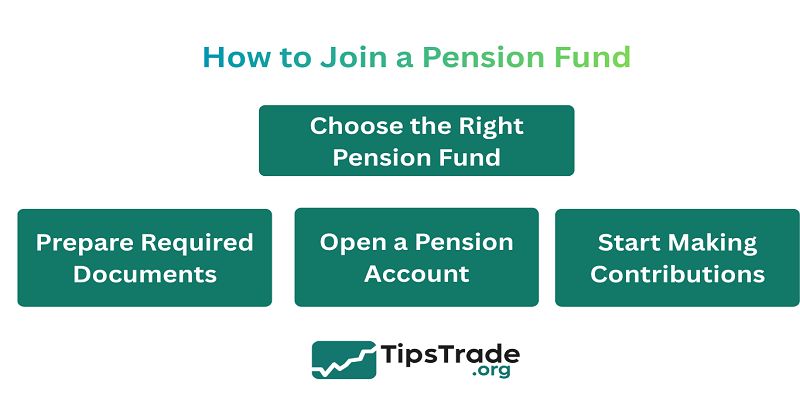
Step 1: Choose the Right Pension Fund
- Selecting the right pension fund is the most critical decision in the process.
- Key factors include risk tolerance, investment horizon, fees, and historical performance.
- Younger participants may prefer growth-oriented funds, while older individuals often choose more conservative options.
- Experience-based reviews indicate that many people choose funds based on brand recognition rather than suitability.
- Research from pension regulators emphasizes aligning fund choice with personal financial goals.
- Comparing multiple options and reading official disclosures improves long-term outcomes.
Step 2: Prepare Required Documents
- Joining a pension fund typically requires basic identification documents, proof of income, and employment or residency information.
- For employer plans, HR departments often assist with paperwork. For private pensions, individuals must complete application forms independently.
- From real-world examples, incomplete documentation is a common cause of delays. Financial institutions recommend preparing documents in advance to ensure a smooth enrollment process.
- Transparency and accuracy are essential to avoid future compliance issues.
Step 3: Open a Pension Account
- Once documentation is approved, participants open a pension account. This account tracks contributions, investment performance, and projected retirement benefits. Many providers now offer digital platforms for account management.
- Expert reviews show that online access increases engagement and contribution consistency.
- According to research from financial technology studies, individuals who regularly monitor their pension accounts are more likely to adjust contributions proactively and achieve better outcomes.
Step 4: Start Making Contributions
- After account activation, contributions begin according to the selected schedule. Contributions may be fixed or flexible, depending on the pension type.
- Automated payments reduce the risk of missed contributions.
- Studies in behavioral finance highlight automation as a key factor in successful long-term saving.
- Real-world reviews confirm that individuals who automate contributions maintain better financial discipline over decades.
How Much Should You Contribute to a Pension Fund?

Minimum vs. Recommended Contributions
Most pension funds specify minimum contribution levels, but experts recommend contributing more when possible.
A common guideline is allocating 10–15% of annual income to retirement savings, including employer contributions.
Research from retirement planning studies supports this benchmark as a sustainable balance between current living expenses and future needs. Reviews of retirees suggest that under-contributing is one of the most common and costly mistakes.
Contribution Strategies by Age
Contribution strategies vary by life stage. Younger individuals benefit from smaller but consistent contributions, while older participants may need higher contributions to catch up. Age-based strategies are widely recommended by financial advisors.
Empirical studies show that individuals who adjust contributions as income grows achieve significantly higher retirement balances. Experience-based reviews highlight the importance of revisiting contribution levels after major life events.
Benefits of Joining a Pension Fund Early
Joining a pension fund early maximizes the power of compound interest. Even modest contributions can grow substantially over decades. Early participation also reduces financial pressure later in life.
According to research from global pension studies, early joiners report higher retirement satisfaction and lower dependency on external support. Real-world examples consistently demonstrate that time in the market is more important than timing the market.
Risks and Things to Consider Before Joining
Investment Risks
Pension funds are subject to market fluctuations, and returns are not guaranteed. Economic downturns can temporarily reduce fund value. Understanding risk profiles is essential before joining.
Expert analyses emphasize diversification as a key risk-management strategy. Reviews of long-term pension performance show that diversified funds recover over time, reinforcing the importance of patience.
Liquidity and Withdrawal Rules
Most pension funds restrict early withdrawals to preserve retirement savings. Penalties may apply for early access. These rules protect long-term outcomes but require careful planning.
Experience-based reviews indicate that misunderstanding withdrawal rules leads to dissatisfaction. Consulting official guidelines ensures realistic expectations and financial preparedness.
Pension Fund vs. Other Retirement Options
| Criteria | Pension Fund | Savings Account | Real Estate |
| Long-term growth | High | Low | Medium |
| Risk diversification | High | Low | Medium |
| Liquidity | Low | High | Low |
| Professional management | Yes | No | Partial |
Expert comparisons consistently show pension funds as the most balanced long-term retirement solution when combined with other assets.
Common Mistakes When Joining Pension Funds

Common mistakes include delaying enrollment, choosing inappropriate risk levels, and failing to review performance. Many individuals also underestimate fees, which can significantly impact long-term returns.
Research from pension oversight bodies highlights education as the most effective solution. Experience-based reviews confirm that informed participants achieve better outcomes and greater confidence.
Conclusion
How to join pension funds is a crucial step toward building a stable and dignified retirement. Pension funds combine disciplined saving, professional management, and long-term investment strategies that individual savings alone cannot match. Research, expert analysis, and real-world experience consistently show that early participation and informed decision-making lead to better outcomes. By choosing the right pension fund, contributing consistently, and reviewing your plan regularly, you can create a reliable source of retirement income and reduce financial uncertainty later in life. The earlier you start, the greater the benefits you will enjoy.