

How to invest in ESG funds is one of the fastest-growing questions in modern portfolio management, sustainable investing strategy, and long-term wealth building. As environmental, social, and governance (ESG) criteria reshape capital markets, more investors are seeking responsible investing options, ethical portfolio allocation, green investment opportunities, and low-carbon funds that align with personal values. ESG investing, socially responsible investing, impact investing, and sustainable finance are no longer niche concepts — they are becoming mainstream investment strategies. Explore the detailed article at Tipstrade.org to be more confident when making important trading decisions.
What Are ESG Funds?
ESG funds are investment vehicles that incorporate environmental, social, and governance factors into the investment selection process. Instead of focusing solely on financial returns, ESG investing evaluates how companies manage carbon emissions, labor practices, board structure, transparency, and ethical governance. These funds may be structured as ETFs, mutual funds, or index funds.
According to research from organizations like the MSCI and Morningstar, companies with strong ESG profiles may demonstrate lower long-term risk exposure. However, ESG funds are not charity vehicles — they are designed to balance financial returns with sustainability metrics.
ESG investing is often confused with socially responsible investing (SRI) or impact investing. While these strategies overlap, ESG funds typically use structured scoring systems and data analytics to evaluate companies. This makes them measurable, comparable, and increasingly standardized across markets.

What Does ESG Stand For?
ESG stands for:
- Environmental: carbon emissions, energy use, water management, climate exposure
- Social: labor standards, diversity, supply chain ethics
- Governance: executive compensation, shareholder rights, board independence
For example, an ESG fund may exclude fossil fuel producers, companies with labor controversies, or firms lacking transparent governance policies. ESG scoring frameworks developed by MSCI or Sustainalytics assign ratings based on risk exposure and management quality.
Investors increasingly use ESG data as a risk management tool rather than purely an ethical screen. Climate regulation, legal penalties, and governance failures can significantly affect long-term returns. By incorporating ESG metrics, funds attempt to identify financially resilient businesses.
How ESG Funds Work
ESG funds typically operate through one of three strategies:
- Negative screening – Excluding specific sectors (e.g., tobacco, coal).
- Positive screening – Selecting companies with high ESG scores.
- Best-in-class selection – Choosing leaders within each industry.
Passive ESG ETFs track ESG-focused indexes created by providers like MSCI. Active ESG mutual funds use portfolio managers to select companies based on both financial and sustainability criteria.
Most ESG funds publish holdings and methodology transparency documents. Investors should review:
- ESG score methodology
- Sector concentration
- Expense ratio
- Tracking error
Transparency is critical to avoid greenwashing — when funds overstate sustainability claims.
ESG vs Sustainable vs Impact Investing
Although often used interchangeably, these strategies differ.
| Strategy | Primary Focus | Investment Goal |
| ESG Investing | Risk-adjusted performance + ESG scoring | Improve long-term resilience |
| Sustainable Investing | Long-term environmental sustainability | Reduce ecological harm |
| Impact Investing | Measurable social/environmental impact | Direct positive change |
Impact investing often involves private markets. ESG investing typically operates in public equity markets through ETFs and mutual funds. Understanding this distinction helps investors align expectations with outcomes.
Why Investors Are Moving Into ESG Funds

ESG assets under management have grown significantly over the past decade. Institutional investors, pension funds, and retail investors increasingly integrate ESG criteria into portfolio construction.
Several drivers explain this trend:
- Climate regulation risk
- Corporate governance scandals
- Consumer demand for sustainability
- Long-term demographic shifts
Research from the US Securities and Exchange Commission emphasizes improved ESG disclosure standards, enhancing transparency across markets.
Investors are not necessarily sacrificing returns. Instead, many view ESG investing as part of modern risk management and capital preservation.
Performance vs Traditional Funds
Meta-analyses from institutions like Harvard University suggest that companies with strong ESG practices often show improved operational efficiency and lower cost of capital. However, performance varies across sectors and market cycles.
During periods of volatility, ESG funds may show defensive characteristics due to sector allocation (often overweight technology, underweight energy). But higher valuations can also create downside risk.
Key evaluation metrics include:
- Sharpe ratio
- Beta
- Drawdown levels
- Expense ratio
ESG funds should be compared on risk-adjusted returns, not just raw performance.
Long-Term Risk Management
Climate risk and regulatory risk are increasingly material. Carbon-intensive companies face transition risk as governments implement emissions regulations. Governance failures can trigger lawsuits and stock price collapses.
ESG investing attempts to identify companies better prepared for:
- Carbon taxation
- Supply chain disruptions
- Workforce diversity regulations
- Shareholder activism
From a portfolio construction standpoint, ESG screening may reduce exposure to high-volatility sectors vulnerable to policy changes.
Ethical and Values-Based Investing
Many investors allocate capital based on personal values. ESG investing allows alignment between:
- Financial objectives
- Environmental concerns
- Social responsibility
For example, younger investors often prioritize climate-friendly portfolios. Retirement investors may want stable governance structures to protect long-term savings.
However, values-based investing must remain diversified. Concentration in narrow thematic funds can increase volatility.
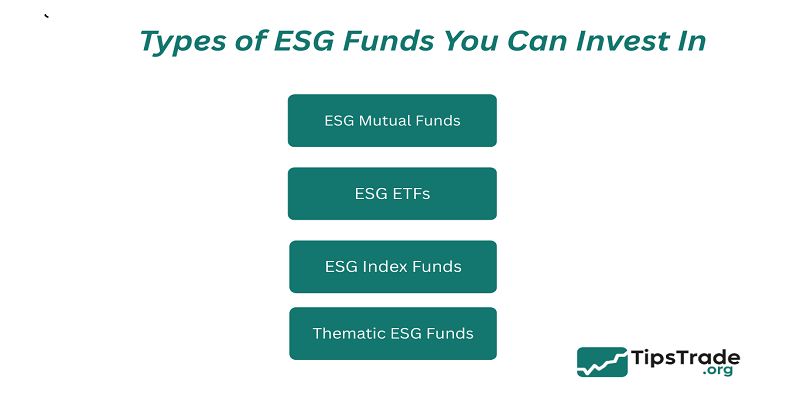
Types of ESG Funds You Can Invest In
ESG ETFs
ESG exchange-traded funds (ETFs) are the most accessible option for retail investors. They:
- Trade intraday
- Offer low expense ratios
- Provide transparency
- Track ESG indices
Passive ESG ETFs typically cost between 0.10%–0.25% annually, making them cost-efficient tools for long-term investing.
ESG Mutual Funds
ESG mutual funds are actively managed. Portfolio managers analyze both financial data and ESG metrics to select securities.
Advantages:
- Professional oversight
- Potential outperformance
- Dynamic allocation
Disadvantages:
- Higher fees (0.50%–1%+)
- Potential style drift
Investors must review fund prospectuses carefully.
ESG Index Funds
Index-based ESG funds replicate sustainability-focused benchmarks. They combine diversification with systematic screening.
These funds may overweight:
- Technology
- Healthcare
- Consumer staples
And underweight:
- Fossil fuels
- Heavy industry
Thematic ESG Funds
Thematic funds focus on specific sustainability themes:
- Clean energy
- Gender diversity
- Water sustainability
- Climate innovation
While potentially high growth, they carry concentration risk and volatility.
How to Evaluate ESG Fund Performance
Expense Ratio
- Even small differences compound over decades.
Risk Metrics
Evaluate:
- Sharpe ratio
- Standard deviation
- Beta
Historical Returns
Compare across:
- 1-year
- 5-year
- 10-year
Holdings Transparency
- Review fund documentation carefully to detect inconsistencies.
Risks of Investing in ESG Funds
- Greenwashing
- High valuations
- Sector bias
- Regulatory changes
Transparency and research mitigate these risks.
ESG Portfolio Allocation Strategy
Conservative Allocation
- Lower equity, higher bonds, partial ESG integration.
Balanced Allocation
- Moderate equity exposure, diversified sectors.
Aggressive Growth Allocation
- High equity exposure, thematic ESG additions.
Conclusion
How to invest in ESG funds ultimately depends on your financial goals, risk tolerance, and long-term investment strategy. ESG investing combines environmental, social, and governance criteria with disciplined portfolio management, allowing investors to pursue sustainable growth without abandoning diversification principles. While ESG funds may help mitigate climate risk, governance failures, and regulatory exposure, they are not guaranteed to outperform traditional funds in every market cycle.