
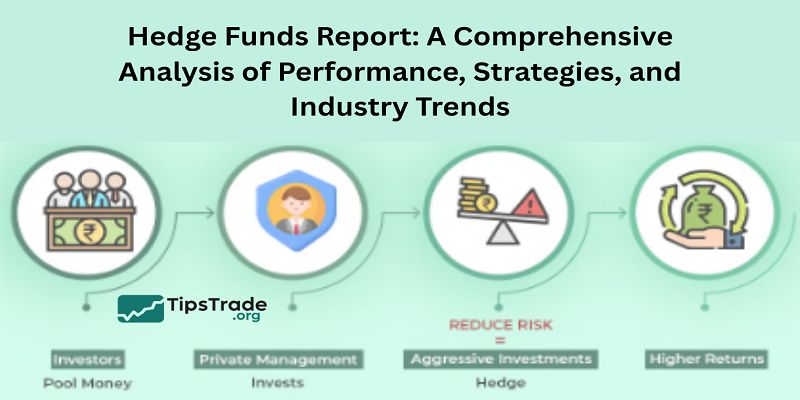
Hedge Funds Report is one of the most valuable resources for understanding the hedge fund industry, providing deep insights into hedge fund performance, investment strategies, assets under management (AUM), and market outlook. For institutional investors, analysts, and sophisticated individuals, these reports help evaluate risk-adjusted returns, identify emerging hedge fund strategies, and assess how funds perform across different market cycles. Explore the detailed article at Tipstrade.org to be more confident when making important trading decisions.
What Is a Hedge Fund? An Overview of the Industry
Definition and Core Characteristics of Hedge Funds
A hedge fund is a privately pooled investment vehicle that uses a wide range of strategies to generate returns, often aiming for absolute returns regardless of market direction. Unlike mutual funds or ETFs, hedge funds are typically open only to accredited or institutional investors and operate under fewer regulatory constraints.
Based on industry analysis from sources such as Investopedia and SEC disclosures, hedge funds commonly employ leverage, derivatives, and short selling to enhance performance or manage risk. In practice, hedge fund managers seek to generate alpha, or excess returns above a benchmark, while actively managing downside risk.
From an analytical perspective, hedge funds differ not only in strategy but also in structure, fee models (commonly “2 and 20”), and liquidity terms. These characteristics are usually explained in detail within a professional hedge funds report.
Size and Global Scope of the Hedge Fund Industry
The global hedge fund industry has grown into a multi-trillion-dollar ecosystem. According to data aggregated by Hedge Fund Research (HFR) and Preqin, total assets under management (AUM) have consistently exceeded several trillion USD in recent years, despite periodic drawdowns during market stress.
Institutional investors—such as pension funds, endowments, and sovereign wealth funds—now represent the majority of hedge fund capital. This shift has influenced fund transparency, reporting standards, and risk controls.
A typical hedge funds report provides regional breakdowns (North America, Europe, Asia), highlighting differences in regulation, strategy preference, and investor behavior. These insights help readers understand where capital is flowing and which regions are driving industry growth.

What Does a Hedge Funds Report Typically Include?
Hedge Fund Performance and Returns Analysis
Performance analysis is the core of any hedge funds report. Rather than focusing only on headline returns, professional reports evaluate risk-adjusted performance, comparing hedge fund returns against benchmarks such as equity indices or bond markets.
Metrics like Sharpe ratio, alpha, beta, and maximum drawdown are commonly used. Research published by Morningstar and CFA Institute emphasizes that hedge funds often aim for smoother return profiles, not necessarily higher absolute returns in bull markets.
Experienced analysts reviewing hedge fund reports often look beyond annual performance, focusing on consistency across market cycles. A fund that performs reasonably well during downturns may be more attractive than one with high volatility and occasional outsized gains.
Common Hedge Fund Investment Strategies
Most hedge funds specialize in specific strategies, which are usually categorized clearly in industry reports. The most common include:
- Long/Short Equity: Taking long positions in undervalued stocks and short positions in overvalued ones.
- Global Macro: Investing based on macroeconomic trends such as interest rates, currencies, and geopolitics.
- Event-Driven: Focusing on mergers, acquisitions, restructurings, or bankruptcies.
- Relative Value / Arbitrage: Exploiting pricing inefficiencies between related securities.
A hedge funds report typically compares the performance of these strategies, showing how each responds to different economic conditions.
This helps investors align strategy exposure with their risk tolerance and market outlook.
Risk Metrics and Volatility Assessment
Risk analysis is a defining feature of professional hedge fund reports. Instead of simple volatility measures, reports often assess downside risk, liquidity constraints, and leverage exposure.
Sources such as CFA Institute research papers highlight that hedge funds can mask risk during stable periods, only revealing vulnerabilities during market stress. Therefore, experienced reviewers pay close attention to drawdowns and recovery times
By presenting scenario analysis and stress testing, hedge funds reports help investors understand how strategies may behave during crises, reinforcing trust and transparency.
Key Trends Shaping the Hedge Fund Industry
Recent Hedge Fund Industry Trends
- Recent hedge fund industry reports indicate several structural shifts. Data from Preqin and HFR shows increasing investor demand for lower fees, greater transparency, and more frequent reporting.
- Another trend is the rise of quantitative and systematic strategies, driven by advances in data analytics and machine learning. At the same time, traditional discretionary managers are adapting by integrating technology into their research processes.
- From an industry review standpoint, these trends suggest that hedge funds are evolving to meet institutional standards, making hedge funds reports more detailed and standardized than ever before.
Macroeconomic Factors Affecting Hedge Funds
- Macroeconomic conditions play a significant role in hedge fund performance. Interest rate changes, inflation trends, and central bank policies directly affect strategy outcomes.
- For example, reports published during periods of rising interest rates often highlight stronger performance in global macro and relative value strategies.
- In contrast, prolonged low-volatility environments may favor equity-focused approaches.
- By contextualizing performance within the broader economic landscape, hedge funds reports help readers avoid simplistic conclusions and better understand why certain strategies outperform at specific times.

Comparing Hedge Funds With Other Investment Vehicles
Hedge Funds vs Mutual Funds
- Hedge funds and mutual funds differ significantly in structure and objectives. Mutual funds are highly regulated, offer daily liquidity, and aim to outperform benchmarks.
- Hedge funds, by contrast, prioritize absolute returns and flexible strategies.
- Industry comparisons from SEC filings and Morningstar show that while hedge funds may deliver diversification benefits, they also involve higher fees and less liquidity.
- A hedge funds report typically summarizes these trade-offs, enabling informed comparisons.
Hedge Funds vs ETFs and Passive Investments
- ETFs are known for low costs and transparency, tracking indices rather than actively seeking alpha. Hedge funds, on the other hand, justify higher fees through active management and complex strategies.
- Professional hedge fund reports often emphasize that hedge funds are not replacements for ETFs but potential complements within diversified portfolios.
- This balanced perspective enhances trustworthiness and aligns with People-First content principles.
Hedge Funds vs Private Equity
- While both hedge funds and private equity funds cater to institutional investors, their investment horizons differ. Hedge funds focus on liquid markets, whereas private equity targets long-term ownership of private companies.
- A hedge fund report may compare these asset classes based on liquidity, risk, and return expectations, helping readers choose appropriate allocations based on their financial goals.
Who Uses Hedge Funds Reports and Why?

Institutional Investors and Asset Allocators
- Pension funds, endowments, and insurance companies rely heavily on hedge funds reports for due diligence. These reports support decisions about manager selection, allocation size, and risk oversight.
- Experience from industry reviews suggests that institutional investors value standardized data, peer comparisons, and historical context more than marketing narratives.
Financial Analysts and Wealth Managers
- For analysts and advisors, hedge funds reports serve as reference documents. They provide benchmarks, performance attribution, and strategy explanations that can be communicated to clients.
- By relying on reputable data sources and transparent methodologies, these reports strengthen professional credibility and trust.
Individual Accredited Investors
- Although access is limited, high-net-worth individuals also use hedge funds reports to educate themselves before committing capital.
- Clear explanations and risk disclosures are particularly important for this audience.
How to Read and Interpret a Hedge Funds Report
Key Metrics to Focus On
Experienced reviewers often prioritize:
- Long-term performance consistency
- Risk-adjusted returns
- Drawdowns and recovery periods
- Strategy diversification
These factors provide a more realistic picture than short-term gains alone.
Common Pitfalls and Misinterpretations
- A common mistake is assuming hedge funds always outperform traditional investments. Research from CFA Institute consistently shows mixed results, emphasizing the importance of manager selection and timing.
- A trustworthy hedge funds report explicitly addresses these limitations, reinforcing credibility.
Conclusion
Hedge Funds Report is more than a performance summary—it is a strategic research tool that combines data, analysis, and context. When used correctly, it helps investors, analysts, and advisors make informed decisions while maintaining realistic expectations. By focusing on transparency, risk awareness, and long-term perspective, hedge funds reports remain an essential resource in modern investment analysis.