

Hedge Funds Long Short is one of the most influential and widely used strategies in the global hedge fund industry. As markets become increasingly volatile and complex, long/short strategies provide hedge funds with the flexibility to pursue absolute returns by exploiting both rising and declining asset prices. This investment approach combines long positions in undervalued assets with short positions in overvalued assets, enabling hedge funds to generate profit in a variety of market environments. Explore the detailed article at Tipstrade.org to be more confident when making important trading decisions.
What Is a Long/Short Hedge Fund?
A Long/Short Hedge Fund is an investment vehicle that buys assets expected to appreciate in value (long positions) and sells borrowed assets expected to decline in value (short positions). The combination of these positions allows hedge funds to capture market inefficiencies, reduce exposure to systemic risk, and generate consistent returns in both bullish and bearish markets.
Long/short strategies originated in the 1940s when Alfred Winslow Jones created the first hedge fund using long and short positions to hedge market risk. Today, long/short strategies remain a core component of hedge fund investing because they provide a balance between opportunity and protection. Unlike traditional long-only portfolios, long/short hedge funds can profit from mispriced securities in both directions.
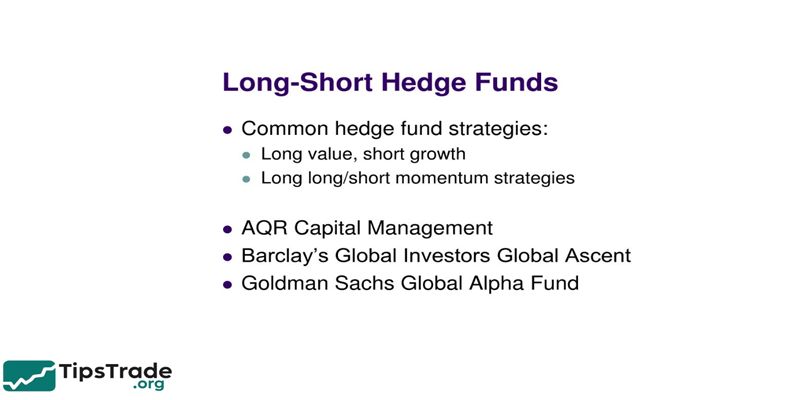
In practice, Hedge Funds Long Short strategies rely on rigorous fundamental analysis, quantitative modeling, or a combination of both to identify securities that are undervalued or overvalued. Fund managers use leverage, derivatives, and market-neutral techniques to enhance returns and reduce exposure to market downturns. This flexibility has made long/short strategies a dominant force in the hedge fund world.
How Long/Short Hedge Funds Work
To understand how Hedge Funds Long Short strategies work, it is crucial to break down the mechanics of long positions, short positions, and how they interact within a portfolio.
Long Positions
A long position is a core concept in investing. When a hedge fund goes long, it buys a security expecting its price to rise. Long positions are built on fundamental or quantitative research that identifies undervaluation, growth potential, or catalysts such as earnings, product launches, or market expansion.
In long/short funds, long positions serve two purposes:
- Generating positive returns when the asset appreciates.
- Balancing risk by offsetting losses from short positions if the market moves against expectations.
Long positions vary in concentration depending on strategy type. Fundamental long/short managers often focus on high-conviction long positions, while quantitative long/short funds may use diversified baskets of long assets.
Short Positions
Short positions are what differentiate Hedge Funds Long Short strategies from traditional asset management.
To take a short position, a hedge fund:
- Borrows shares from a broker.
- Sells the borrowed shares at the current market price.
- Later repurchases the shares (hopefully at a lower price).
- Returns the shares to the broker.
- Keep the difference as profit if the price falls.
Short selling allows hedge funds to profit from market declines or from overvalued securities. However, it carries significant risks:
- If the price rises instead of falls, losses can be unlimited.
- Short squeezes can force forced buybacks at inflated prices.
- Regulatory restrictions may limit short selling during crises.
Despite these risks, short selling is essential to long/short strategies because it provides downside protection and allows market-neutral positioning.
Combining Long and Short Positions
The heart of Hedge Funds Long Short strategy is combining long and short positions to create a balanced portfolio. The goal is to generate returns based on security selection rather than market direction.
Two central concepts govern portfolio exposure:
Net Exposure
- Net exposure = (Long Exposure – Short Exposure)
- A positive net exposure indicates a bullish bias. A negative net exposure indicates a bearish bias. A near-zero net exposure indicates a market-neutral strategy.
Gross Exposure
- Gross exposure = (Long Exposure + Short Exposure)
- This measures how aggressively the fund is using leverage and is closely watched for risk management.
Long/short hedge funds may be:
- Market-neutral (net exposure ≈ 0)
- Directional long/short (positive net exposure, bullish)
- Bearish long/short (negative net exposure)
This flexibility allows hedge funds to express market views while reducing systemic risk.
Types of Long/Short Strategies

Hedge Funds Long Short strategies come in many forms depending on asset class, methodology, and investment philosophy.
Equity Long/Short
This is the most common long/short strategy. Equity long/short managers invest in stocks they believe are undervalued while shorting stocks they believe are overvalued.
There are two main styles:
- Fundamental long/short equity
- Quantitative long/short equity
Fundamental managers rely on business analysis, earnings models, and valuation metrics. Quantitative managers use statistical patterns, factor models, and machine learning.
Long/Short Credit
Long/short credit strategies trade corporate bonds, credit default swaps (CDS), and distressed debt. For example:
- Long positions may target undervalued bonds of stable companies.
- Short positions may target overvalued or risky credit issuers.
These strategies benefit from credit cycles, interest rate changes, and mispricing between similar credit instruments.
Sector-Focused Long/Short
Some hedge funds specialize in specific sectors such as:
- Technology
- Healthcare
- Energy
- Financials
- Consumer discretionary
Sector expertise allows managers to gain deep insight into industry trends, competitive dynamics, and valuation discrepancies.
Quantitative Long/Short
Quantitative long/short funds rely entirely on algorithms and statistical models. Popular quant strategies include:
- Statistical arbitrage
- Factor investing (value, momentum, size, quality)
- Machine-learning-driven stock selection
Systems continuously scan markets for inefficiencies and execute trades automatically.
Why Hedge Funds Use Long/Short Strategies

There are several reasons why Hedge Funds Long Short strategies are essential:
Exploiting Market Inefficiencies
- Long/short strategies capitalize on mispriced assets, benefiting from both rising and falling markets.
- Skilled hedge fund managers can identify inefficiencies before the broader market reacts.
Generating Alpha
- Alpha represents returns above the market benchmark. Long/short strategies enable managers to express unique insights and generate true active performance.
Downside Protection
- Short positions act as a form of insurance. During market downturns, short positions can offset losses from long positions, stabilizing portfolio returns.
Flexibility in Different Market Conditions
Long/short hedge funds can adapt to:
- Bull markets
- Bear markets
- Sideways markets
This makes long/short strategies suitable for volatile environments.
Key Metrics Used to Evaluate Long/Short Hedge Funds
Evaluating the performance of Hedge Funds Long Short requires specialized metrics.
Net Exposure
- Measures directional bias. Higher net exposure means higher sensitivity to market movements.
Gross Exposure
- Indicates leverage. High gross exposure means aggressive positioning.
Beta-Adjusted Exposure
- Shows sensitivity to market index changes after adjusting for volatility.
Sharpe Ratio
- Measures risk-adjusted returns. Higher Sharpe ratios indicate better performance for the amount of risk taken.
Information Ratio
- Measures active management skill relative to a benchmark.
Risks of Long/Short Hedge Funds

No strategy is without risk. Hedge Funds Long Short face the following challenges:
Short Squeeze Risk
- If heavily shorted stocks rise sharply, funds may be forced to cover positions at large losses.
Leverage and Margin Calls
- Leverage magnifies both gains and losses. Falling asset prices can trigger margin calls, requiring forced liquidation.
Liquidity Risk
- Thinly traded assets can create difficulties in entering or exiting positions without moving market prices.
Model Risk
- Quantitative long/short strategies may fail during extreme market conditions.
Conclusion
Hedge Funds Long Short strategies are a vital component of modern finance, allowing hedge funds to capture upside potential while managing downside risks. By combining long and short positions, hedge funds can exploit market inefficiencies, generate alpha, and navigate volatility more effectively than traditional long-only portfolios.