

Growth stocks are among the most popular vehicles for investors seeking capital appreciation in dynamic sectors. These are shares of companies expected to expand earnings and revenues at a rate notably higher than the market average. But with high potential comes higher risk. In this comprehensive guide, we’ll explore what growth stocks are, how to identify high-quality growth names, strategies to invest wisely, and pitfalls to watch out for. Whether you’re new to stock investing or looking to enhance your growth portfolio, this article is designed to help you make informed decisions grounded in data, examples, and real-world experience.
Understanding Growth Stocks

Definition & Core Concept
- A growth stock is a share of a company whose earnings and revenue are expected to grow faster than the average market or peer firms.
- Growth investors focus less on immediate returns like dividends and more on future capital gains.
- These companies typically reinvest their profits back into the business — for R&D, expansion, marketing, acquisitions — rather than paying large dividends.
- From an investor’s view, growth stocks are attractive because they allow participation in disruptive trends (AI, cloud computing, biotech), where innovation drives exponential gains.
- Yet, their valuations often rest on expectations; if growth falters, the downside can be steep.
Key Characteristics & Hallmarks
Growth stocks tend to exhibit several common traits. Below are essential features to look for:
As Cabot Wealth outlines, among the nine characteristics of great growth stocks are profitability, strong balance sheet, addressable market size, and institutional support. Experienced growth investors know that a company with all six or more of these traits is more likely to deliver sustained growth.
>>See more:
- Stock Issuance: A Detailed A-to-Z Guide for Investors
- What are stock exchanges and how do they work?
- Understanding Dividend stocks and how to invest in them
- What Is Stock Valuation? Notes When Valuation Of Stocks
Growth Investing Strategy & Rationale
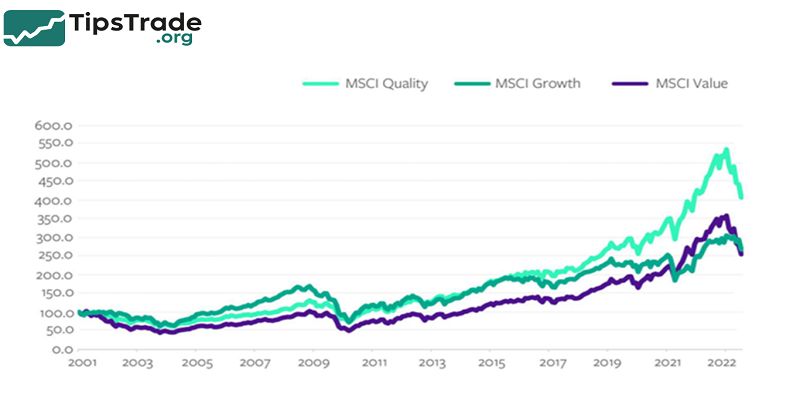
Growth vs Value Two Sides of Equity Investing
Growth investing and value investing are often depicted as opposing styles. Growth focuses on future potential, while value seeks undervalued stocks relative to current fundamentals.
- Growth: Emphasizes capital appreciation, high growth rates, and reinvestment.
- Value: Focuses on margin of safety, lower price multiples, often pays dividends.
Interestingly, many modern strategies blend both (i.e., GARP — Growth at a Reasonable Price) to capture upside without paying extreme premiums.
Why Growth Stocks Matter in a Portfolio
Here are reasons investors allocate to growth stocks:
- Outperformance in bull markets: In expansion phases, optimism and capital flow often favor high-growth names.
- Leverage to innovation: Growth stocks let investors ride structural trends: AI, biotech, green energy, fintech.
- Compounding potential: If chosen well and held over long duration, growth stocks can multiply principal many times.
- Diversification: They offer a different risk / return profile compared to dividend or income stocks.
However, because of their sensitivity to expectations, they can suffer sharply in downturns. The trick is strategic allocation, disciplined entry/exit, and risk management.
When Growth Outperforms & When It Doesn’t
- Growth stocks tend to shine in low-interest or accommodative monetary regimes, when investors are willing to pay for future earnings.
- Conversely, in rate-hike cycles or recessions, value and defensive stocks often outperform.
- As an investor, your timing, understanding of macro trends, and risk tolerance matter deeply in growth investing.
How to Evaluate & Find Quality Growth Stocks
Financial Metrics & Screening Criteria
Here’s a checklist (with metrics) to evaluate growth candidates:
- Revenue Growth & Earnings Growth: Look for sustained YoY growth of 15%–30%+.
- PEG Ratio: Price-to-Earnings / Growth rate — if PEG ≤ 1, valuation may be more reasonable.
- Return on Equity (ROE): High ROE (20% or more) indicates efficient capital use.
- Gross margin & margin expansion: Must show potential to scale.
- Low debt / strong balance sheet: Less debt gives flexibility during downturns.
- Free Cash Flow (FCF): Positive and growing FCF is a strong sign of financial health.
- Earnings surprise consistency: Track record of beating estimates.
- Relative strength / momentum indicators: Stocks with strong price momentum often attract institutional flows.
Cabot’s list of 9 traits also emphasizes a large addressable market, institutional support, and leadership in an industry.
Qualitative Factors: Moat, Vision, Execution
Numbers alone don’t ensure success. Assess qualitative factors:
- Competitive moat: Can the firm defend margins via patents, network effects, switching costs?
- Management quality: Visionary leadership, operational discipline, track record.
- Product roadmap / innovation pipeline: Are they investing in future lines of business?
- Industry secular tailwinds: Is demand growing (e.g., AI, cloud, healthcare tech)?
- Customer base / retention: High retention or recurring revenue models are ideal (e.g. SaaS).
Screening & Tools
- Use platforms like Morningstar, Yahoo Finance, Stockopedia, Seeking Alpha to screen for high-growth metrics and rank candidates.
- For example, Stockopedia’s “checklist for growth stocks” includes momentum, earnings growth, and valuation alignment
Technical and momentum overlays can help with timing and confirmation. Some strategies combine CANSLIM rules (from William O’Neil) to pick growth winners.
Building Growth Stock Strategies
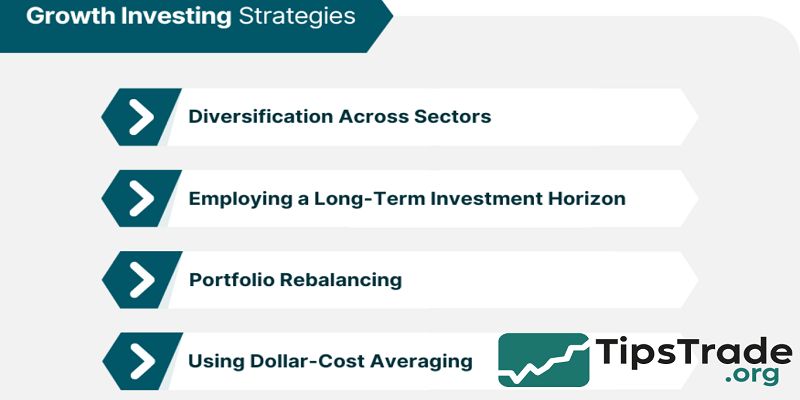
Core Strategies (Long-Term / Dollar-Cost Averaging)
- One of the most reliable approaches is buy-and-hold.
- The idea: identify high-quality growth companies and hold them over multi-year horizons (5–10+ years).
- Dollar-cost averaging (investing a fixed amount periodically) helps mitigate timing risk. This strategy benefits from compounding over time.
- In real experience, many successful growth investors find their best returns not from frequent trading, but from patient holding and letting winners run.
Momentum / Trend-Based Strategies
- Growth stocks often move sharply, and momentum strategies aim to ride these trends.
- Entry could be based on breakout patterns (cup & handle, relative strength) and technical signals.
- For example, O’Neil’s approach recommends entering on breakouts and placing stop-loss ~8% below entry.
- However, momentum trades require discipline: exits must be triggered when trends reverse.
Risk Management & Position Sizing
Because growth stocks are inherently volatile:
- Limit exposure: Don’t allocate more than 10–20% of equity portfolio to aggressive growth names.
- Diversify across sectors & geographies: Reduce idiosyncratic risk.
- Set stop-loss / trailing stop rules: Protect from sharp drawdowns.
- Rebalancing: Trim winners occasionally to realize gains and reposition.
GARP & Balanced Approaches
- Growth-at-a-Reasonable-Price (GARP) strategies try to capture growth while avoiding overpaying. Stocks with PEG around 1 or below are targetable.
- Blending growth and value (i.e. “core-satellite” portfolios) helps smooth volatility while retaining upside.
Examples of Growth Stocks & Case Studies
Iconic Growth Names & Their Stories
- Amazon (AMZN): Started with low margins, reinvested aggressively, built ecosystem of services (AWS, Prime).
- Tesla (TSLA): Captured the EV and energy storage disruption trend; bold leadership.
- Nvidia (NVDA): Transitioned from graphics to AI/data center dominance.
- Netflix (NFLX): Shifted from DVD to streaming, global scaling.
- Shopify (SHOP): Enabling e-commerce platforms with recurring SaaS revenue.
Each has exhibited many growth traits: massive addressable markets, competitive moats, reinvestment, and scaling.
Emerging / International Growth Names
- In emerging markets, some mid- and small-cap growth companies offer large upside, though with higher risk.
- For example, fintech or biotech firms in Asia, Latin America, or Southeast Asia may show explosive growth but require due diligence.
Performance Comparison
- Over a 5- to 10-year period, top growth stocks often outperform broad indices — though with much higher volatility.
- Time in market matters: many gains are concentrated in a few years.
- Studies from funds and index data show that growth-focused indexes outperform in strong bull cycles but lag during corrections.
- This underscores the importance of timing and diversification.
Risks, Downsides & Common Pitfalls

Valuation & Speculative Bubbles
- Because growth stocks often price future expectations, they are vulnerable to disappointment.
- Overvaluation risk is high. As Investopedia cautions, if expectations fail, sharp declines can follow.
Execution Risk
- A great vision is worthless if execution fails.
- Missed milestones, cost overruns, weak management can derail growth.
Macroe & Interest Rate Risk
- Rising interest rates reduce the present value of future earnings, hurting high-growth names disproportionately.
- In downturns, investors often rotate away from growth to value or defensive stocks.
Overconcentration
- Putting too much capital in a few high-growth names increases exposure to idiosyncratic risk. Diversification is key.
Market Sentiment & Momentum Reversals
- Momentum trades can reverse quickly. Emotional or herd behavior can amplify corrections.
Practical Steps for Investors
- Set clear goals & risk tolerance — define what percentage you’ll allocate to growth.
- Use screening & filtering tools — criteria defined earlier (growth rate, ROE, PEG, margins).
- Do deep due diligence — read quarterly letters, investor calls, management commentary.
- Diversify — spread across sectors, geographies, cap sizes.
- Entry discipline — use technical confirmation or staged buying rather than full exposure at once.
- Exit rules — set stop-loss levels, trailing stops, or re-evaluate when growth slows.
- Regular review — monitor performance, fundamentals, and reallocate if necessary.
Many successful investors recast positions quarterly, trimming overinflated names and redeploying into emerging winners.
Conclusion
Growth stocks offer exciting potential for capital gains, especially when aligned with secular trends and strong fundamentals. But they require discipline, deep research, and risk controls. The article above from Tipstrade.org has just provided you . We hope that you find it useful. Wishing you successful trading!
>> See more:
- What is Stock Liquidity? Why It’s Important for Investors
- What is Stock Market Index? Top 8 Stock Market Index You Should Know About
- What Is a Stock Broker? Essential Skills and Average Salary of Being a Stock Broker
- How To Read A Stock Chart: Exploring Key Types & Pro Tips