

Best money market funds have become a central topic for investors seeking capital preservation, short-term liquidity, and competitive yields without taking on excessive risk. In a market shaped by interest rate cycles, monetary policy decisions, and cash management strategies, money market funds are often viewed as a safe investment vehicle, a cash equivalent, and a low-volatility option for parking funds temporarily. Investors frequently compare yield stability, expense ratios, government-backed securities, short-term debt instruments, and liquidity features when searching for the best money market funds. Explore the detailed article at Tipstrade.org to be more confident when making important trading decisions.
What Makes a Money Market Fund “Best”?
Yield vs Safety vs Liquidity
When analysts describe the “best” money market funds, they are rarely referring to yield alone.
Money market funds are designed primarily for stability and liquidity, not aggressive growth. In practice, professional fund selectors evaluate a balance between competitive yield, principal protection, and daily accessibility.
Higher yields often come from exposure to prime money market instruments, such as high-quality commercial paper, while lower-risk government money market funds focus on U.S. Treasuries and agency securities. Investors who prioritize safety may accept slightly lower yields in exchange for reduced credit risk.
Liquidity is equally critical. Most money market funds allow same-day or next-day redemptions, making them suitable for emergency cash or short-term needs. From a People First perspective, the “best” fund depends on the investor’s time horizon, risk tolerance, and cash flow requirements rather than headline returns.
Expense Ratios and Cost Efficiency
Expense ratios play a disproportionate role in money market funds because overall yields tend to be modest. Even a difference of 0.10%–0.20% in fees can materially affect net returns, especially in low-rate environments.
From an expert standpoint, analysts examine whether a fund’s expense ratio is competitive within its category and whether fee waivers are being used to temporarily support yields. Some large fund providers have historically waived fees to prevent negative returns during ultra-low interest rate periods.
Cost efficiency also reflects operational scale. Funds with larger assets under management (AUM) often benefit from lower per-unit costs. Investors evaluating the best money market funds should always look beyond gross yield and focus on net yield after expenses, a principle consistently emphasized by institutions like Morningstar.
Fund Size, Stability, and Track Record
Fund size and longevity contribute to perceived quality. Large money market funds typically offer better diversification, stronger liquidity buffers, and more robust risk management systems. A long operating history also provides insight into how the fund performed during past market stress, such as the 2008 financial crisis or 2020 liquidity disruptions.
From an experience-based perspective, institutional investors often favor funds with established sponsors and consistent management teams. While size alone does not guarantee superior outcomes, it often correlates with operational resilience and regulatory compliance, key factors in determining which money market funds are considered “best” by professionals.
Types of Money Market Funds to Consider
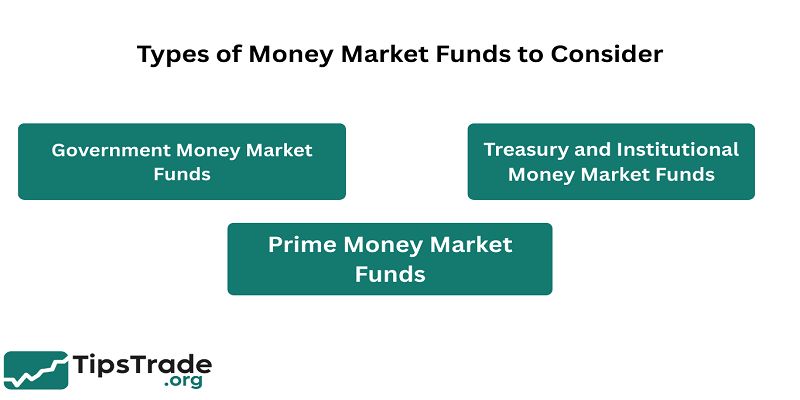
Government Money Market Funds
Government money market funds invest primarily in U.S. Treasury bills, government agency securities, and repurchase agreements collateralized by government debt. These funds are widely regarded as the safest category of money market funds due to minimal credit risk.
Investors who prioritize capital preservation often gravitate toward government money market funds, particularly during periods of market uncertainty. Although yields may be slightly lower than prime funds, the trade-off is enhanced stability and regulatory support. According to SEC guidelines, these funds are exempt from certain liquidity fees and redemption gates, further reinforcing investor confidence.
For conservative investors, government money market funds are frequently considered among the best options for emergency savings, retirement cash allocations, or institutional cash reserves.
Prime Money Market Funds
Prime money market funds invest in a broader range of short-term corporate debt, including commercial paper and certificates of deposit issued by high-quality financial institutions. This expanded investment universe can lead to higher yields, especially when credit spreads widen.
However, prime funds carry additional risk. Regulatory reforms introduced after 2008 require institutional prime funds to use floating net asset values (NAVs), reflecting small daily price fluctuations. Retail prime funds may still maintain a stable NAV but can impose liquidity fees during periods of stress.
From a People First lens, prime money market funds may be best suited for investors with higher risk tolerance who understand the trade-offs between yield and stability. They are often used by experienced investors seeking incremental income on idle cash.
Treasury and Institutional Money Market Funds
Treasury-only money market funds represent a subset of government funds that invest exclusively in U.S. Treasury securities. These funds are often favored by investors seeking maximum credit safety and potential state tax advantages.
Institutional money market funds, on the other hand, cater to corporations, pension funds, and large investors. They typically feature higher minimum investments and lower expense ratios due to scale. Institutional investors evaluate these funds based on liquidity stress tests, counterparty exposure, and regulatory disclosures.
While retail investors may not access all institutional funds, understanding their structure provides insight into professional standards used to define the best money market funds.
Best Money Market Funds By Investor Need

Best Money Market Funds for Safety
- Safety-focused investors prioritize credit quality, government backing, and regulatory protections. Government and Treasury money market funds often rank highest in this category.
- These funds typically maintain high daily and weekly liquidity ratios, ensuring investors can access cash even during periods of market stress.
- Real-world examples show that during volatile markets, investors often rotate from prime funds into government funds, reflecting a preference for stability.
- Analysts frequently cite these funds as the best money market funds for conservative portfolios, retirement accounts, and risk-averse investors.
Best Money Market Funds for Higher Yield
- Yield-oriented investors look for funds that maximize income without straying far from the money market mandate.
- Prime money market funds and certain institutional share classes may offer higher yields due to broader investment options and lower expense ratios.
- However, professionals emphasize that higher yield does not equate to higher returns in all conditions.
- Yield spreads can compress rapidly when interest rates fall, and credit risks can surface unexpectedly.
- Experienced investors often diversify across multiple funds rather than relying on a single high-yield option.
Best Low-Cost Money Market Funds
- Low-cost money market funds focus on minimizing expense ratios to preserve net returns. Large providers with significant assets under management often dominate this category.
- From an expertise standpoint, low fees are especially important when interest rates are low, as fees can consume a significant portion of gross yield.
- Cost-conscious investors often consider these funds best for long-term cash allocations, such as holding cash within brokerage accounts or retirement plans.
Best Money Market Funds for Short-Term Cash Parking
- Short-term cash needs, such as upcoming expenses or transaction buffers, require immediate liquidity and minimal risk.
- Funds with high daily liquidity and stable NAVs are generally preferred.
- Professionals managing corporate cash often favor government money market funds for this purpose, citing predictability and regulatory safeguards.
- Retail investors use similar criteria when selecting funds for emergency savings or near-term goals.
Key Metrics to Compare Before Choosing a Fund
7-Day SEC Yield
- The 7-day SEC yield is a standardized measure designed to reflect a fund’s current income potential after expenses. It allows investors to compare yields across funds on an apples-to-apples basis.
- Experts caution that the 7-day yield is not a guarantee of future returns but rather a snapshot based on recent income.
- Investors seeking the best money market funds should monitor this metric over time rather than focusing on a single data point.
Expense Ratio and Fee Waivers
- Expense ratios directly reduce investor returns. Some funds temporarily waive fees to remain competitive, particularly during low-rate environments.
- While fee waivers can enhance short-term yields, they may be withdrawn when market conditions change.
- Trustworthy analysis requires understanding whether a fund’s expense advantage is structural or temporary.
- Professionals recommend reviewing fund prospectuses and annual reports for transparency around fee policies.
Portfolio Composition and Credit Quality
- Portfolio disclosures reveal the types of securities a fund holds, their maturities, and their credit ratings.
- High-quality money market funds typically invest in securities rated in the top short-term credit categories.
- Analysts often review portfolio composition to assess concentration risk and exposure to specific issuers or sectors. This level of scrutiny reflects institutional standards used to identify best-in-class funds.
Liquidity Levels and Redemption Rules
- Liquidity metrics, such as daily and weekly liquid assets, indicate how easily a fund can meet redemptions.
- Regulatory requirements mandate minimum liquidity thresholds, but many top funds exceed these minimums.
- Understanding redemption rules is essential, particularly for prime funds that may impose fees during periods of stress.
- Investors seeking the best money market funds should prioritize clarity and transparency in liquidity management.
Risks and Limitations of Money Market Funds
Interest Rate Risk
- Although money market funds have short maturities, interest rate changes still affect yields. When rates fall, income declines quickly, reducing the attractiveness of these funds compared to other options.
- Professionals emphasize that money market funds are not designed to hedge against inflation or provide long-term growth. Their role is to preserve capital and provide liquidity.
Liquidity and Redemption Risk
- In extreme market conditions, some funds may impose liquidity fees or redemption gates.
- While such measures are rare, they highlight the importance of understanding fund structure and regulatory provisions.
- Historical examples demonstrate that government money market funds are less likely to face such restrictions, reinforcing their reputation for stability.
Differences Between MMFs and Savings Accounts
- Money market funds are often compared to high-yield savings accounts. While both serve as cash management tools, money market funds are investment products subject to market dynamics, whereas savings accounts are bank deposits insured by government agencies.
- Understanding these distinctions helps investors choose the best option for their specific needs.
How Professionals Evaluate the Best Money Market Funds

Institutional vs Retail Fund Selection
- Institutional investors apply rigorous criteria when selecting money market funds, including stress testing, counterparty analysis, and regulatory compliance. Retail investors can benefit by adopting similar principles, even if simplified.
- Experience shows that institutional practices often set the standard for what is considered “best” in the money market space.
Role of Credit Analysis and Regulation
- Regulatory oversight by bodies such as the SEC plays a central role in maintaining market stability. Disclosure requirements and liquidity rules enhance transparency and investor protection.
- Professionals rely on these frameworks when evaluating fund quality, underscoring the importance of regulation in defining best practices.
Why “Best” Changes Over Time
- Market conditions, interest rates, and regulatory environments evolve. A fund considered best today may not hold that position tomorrow.
- Experienced investors regularly review their holdings to ensure continued alignment with their objectives, highlighting the dynamic nature of money market fund selection.
Best Money Market Funds vs Other Cash Alternatives

Money Market Funds vs High-Yield Savings Accounts
High-yield savings accounts offer simplicity and insurance protection, while money market funds provide potentially higher yields and broader diversification.
Choosing between them depends on risk tolerance, liquidity needs, and yield expectations.
Money Market Funds vs Treasury Bills
Treasury bills offer direct exposure to government debt with defined maturities, while money market funds provide diversification and convenience.
Professionals often use a combination of both to optimize cash management strategies.
When Each Option Makes Sense
No single option is universally superior. The best choice depends on time horizon, liquidity needs, and risk preferences.
This balanced perspective aligns with People First content principles, avoiding one-size-fits-all recommendations.
Conclusion
The best money market funds are not defined by a single metric or ranking but by how well they align with an investor’s risk tolerance, liquidity needs, and income expectations. By focusing on yield after fees, credit quality, liquidity management, and regulatory transparency, investors can make informed decisions grounded in realism rather than hype.