

Should I choose CFDs or stocks? This is a question that almost every new investor asks when they start learning about the financial market. Each offers unique opportunities and risks to investors like you. In the article below, we will dissect every aspect to help you make the most informed decision.
Understanding CFD and stock trading
To accurately answer the question “Should I choose CFDs or stocks,” you first need to understand what CFD and Stock Trading are in the content section below.
What is CFD trading?
A CFD (“contract for difference”) is a method of trading financial derivatives. Specifically, investors can speculate on the price movements of a financial product from the time they open a position until they close it. The range of CFD trading instruments is highly diverse, including stocks, indices, commodities, currency pairs, cryptocurrencies, and many other asset classes.
Below are some notable features of CFDs:
- Ownership: CFD investors make money from asset price changes rather than owning the underlying item itself.
- Leverage: Since investors only need to deposit a tiny percentage of the entire transaction value, called a margin, to create a position, they spend much less when trading CFDs.
- Long and short positions: With CFD trading, investors may profit from rising and falling prices by initiating long or short positions.
- Markets: With CFD trading, investors may trade on more than 15,000 markets continuously.
- Taxes: Although stamp duty is not necessary for CFD trading, traders usually have to pay capital gains tax.

>>See more:
- How to Set Stop Loss in CFD Trading to Manage Risk
- Is CFD difficult to learn for beginners? The Truth Explained
- Are CFDs Legal? Everything You Need to Know Before Trading
- Who is CFD for? Find Out Who Should and Shouldn’t Enter This Market
What is stock trading?
Should I choose CFDs or stocks? Stock trading, also known as stock investing, is one of the simplest and most popular ways to participate in the financial markets. In simple terms, this approach involves investing in publicly listed companies that you expect to perform well over the long term.
Key characteristics of stock investing include:
- Ownership: Unlike CFD trading, when investing in stocks, the investor becomes the full owner of the asset and enjoys the privileges of a shareholder.
- Leverage: Investors must pay the full cost of the financial asset, making it less risky since losses cannot exceed the investment’s value.
- Opening long and short positions: Stock trading can be profitable only if the asset’s price is rising.
- Markets: You can buy only stocks and ETFs (exchange-traded funds) when investing.
- Taxes: When investing in stocks, you are required to pay both stamp duty and capital gains tax.

CFD trading vs. stock trading: Side-by-side comparison
This is the most important part that can somewhat help you answer the question “Should I choose CFDs or stocks?” . So, between CFD and stock trading, there are the following main differences:
Ownership
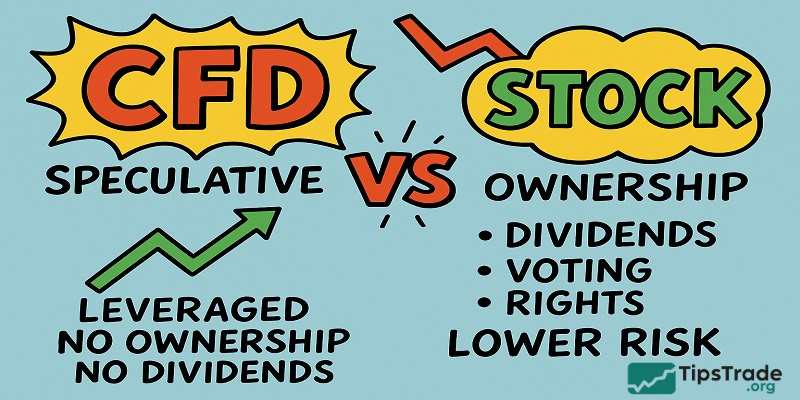
Should I choose CFDs or stocks? When you sell stocks or buy them, you’re dealing with real ownership. Stocks give you rights, dividends, and a piece of the company. In contrast, a CFD trader holds no ownership, they’re only in it for the movement of the asset’s price.
Leverage and margin
CFD trading allows you to trade with leverage, which means you can control a larger sum of money with a small deposit. It can increase your profits but also amplify your losses. Stock trading typically does not involve leverage, so you need to have enough money to buy shares directly.
Short selling
Opening short positions is possible with stocks and CFDs on stocks. Traders can sell stocks and buy them back later at a lower price if they anticipate that stock prices will fall. However, short positions are even more profitable with CFDs on stocks, as there are no borrowing costs.
Trading costs
Should I choose CFDs or stocks? There is often no commission associated with trading CFDs; you only pay the spread and associated costs. But, depending on your broker, dealing with stocks will probably result in commissions and stamp duty payments.
Regulatory environment
Should I choose CFDs or stocks? The regulatory environment in which an asset is invested is among the most crucial factors to take into account. There are several significant distinctions between CFD and Stock in this regard. Regulators impose stringent regulations on stocks traded on regulated exchanges, such as the London Stock Exchange and the New York Stock Exchange.
Most CFD trades occur through brokers on the over-the-counter (OTC) market. The absence of a centralized exchange for trading CFDs may put investors at risk for things like price manipulation and counterparty risk.
Pros and cons of CFD trading vs. stock trading
Pros and cons of CFD trading
|
✅ Advantages |
❌ Disadvantages |
|---|---|
|
Leverage Trading — Trade with a small margin for larger exposure |
High Risk from Leverage — Losses are amplified just like gains You may lose more than your margin or invested amount |
|
Go Long or Short — Ability to profit from both rising and falling markets |
Volatility & Monitoring – Requires constant tracking Margin calls and stop-loss triggers are common |
|
Lower Capital Outlay — Margin-based trading means smaller amounts of money can control larger trades |
Higher Fees & Costs – Includes overnight funding charges, spreads, and commissions — unsuitable for long-term holding |
|
Access to Multiple Markets — Trade across shares, indices, forex, commodities, and crypto in one account |
No Ownership or Dividends – No shareholder rights
Dividend adjustments are made to your account but not paid directly |
Pros and cons of stocks trading
|
✅ Advantages |
❌ Disadvantages |
|---|---|
|
Long-Term Growth & Stability — Suitable for investors with a long-term horizon Blue-chip companies (e.g., Apple, Microsoft, Reliance) offer stability, growth, and dividends |
High Capital Requirement — You need to pay the full price upfront. Example: 100 Tesla shares at $250 = $25,000 cash |
|
Ownership & Shareholder Rights — Buying stocks means owning part of the company with voting rights at AGMs and corporate influence |
Limited to ‘Going Long’ – Profits mainly when stock prices rise Short selling is possible but complex and costly |
|
Dividends as Passive Income — Many companies pay dividends, which can be reinvested for compounding |
Market Volatility – Prices fluctuate due to macroeconomic factors, earnings, and sentiment Trying to ‘time the market’ is risky |
|
Lower Fees Compared to CFDs — Generally fewer costs (brokerage, custody, stamp duty) with no overnight funding charges |
Capital Gains Tax (CGT) – Profits are often taxable in many countries, reducing overall returns |
Should I choose CFDs or stocks?
So, should I choose CFDs or stocks? The choice completely depends on your goals:
- Choose Stocks if: You want to take fewer chances, earn dividends, and gradually increase your wealth. Long-term investors who are saving for retirement, schooling, or future financial security find this option excellent.
- Choose CFDs if: You are comfortable with high risk, want short-term opportunities, and can actively monitor the market. This option is best for experienced traders with strong risk management skills.

Conclusion
Should I choose CFDs or stocks? Choosing between CFDs or Stocks isn’t about which one is better, but which one fits your “shoe size”.
- Stocks are a game of patience and accumulation.
- CFDs are a game of skill, speed, and iron discipline.
Many professional investors now choose a hybrid approach: 80% of capital stays in long-term stocks for dividends, while 20% is used for CFD trading to boost short-term returns or hedge risks. Hopefully the article has provided you with useful information. Wishing all traders success!
See more:
- Scalping vs day trading in CFD: The key differences explained for all traders
- Analyze the Differences Between Spread and Commission Fees in CFD Trading
- Hedging vs CFD: Differences, Pros & Cons, and How to Apply Them Effectively in Trading
- CFD vs Spread Betting: What’s the Difference? Which Trading Method Should You Choose?