

In CFD trading, spread and commission fees are the two most common charges that every trader encounters. Analyzing the differences between spread and commission fees not only helps you optimize profits but also enables you to choose the right account type that aligns with your trading style. So, how do spread and commission differ, and which pricing model is more advantageous in specific trading scenarios? Let’s explore the details in the article below!
Understanding the spread and commission fees in CFD trading
What is spread in CFD trading?
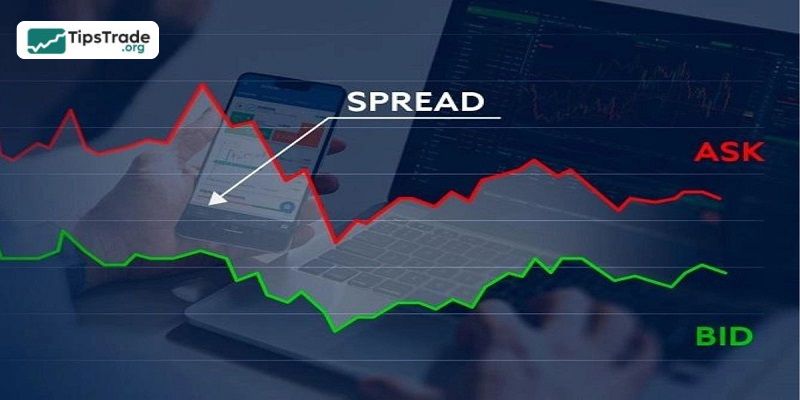
Spread in CFD trading represents the difference between the Ask price (selling price) and the Bid price (buying price) of a particular asset. Essentially, this is the cost you incur when executing a buy or sell order in the Contracts for Difference market. Spread can be expressed in two ways:
- In pips: A pip is the smallest unit of price movement in CFD trading. For example, if the spread of the EUR/USD pair is 10 pips, it means you must pay an additional 0.0010 (equivalent to 10 pips) above the bid price on each trade.
- As a percentage: Spread can also be expressed as a percentage of the asset’s price. For instance, if the spread of the EUR/USD pair is 0.89%, it means you pay an extra 0.89% above the bid price for each transaction.
Example: If the bid price for the EUR/USD currency pair is 1.1200 and the ask price is 1.1210, the spread of this currency pair is 10 pips or 0.89%. That means:
- If you’d like to purchase Euros, the exchange rate is $1.1210 for 1 Euro.
- If you want to sell Euros, you will receive $1.1200 for each Euro.
See more:
- Everything you need to know about CFDs
- CFD Leverage Basics All Traders Should Know
- Common Types of CFD Cost and How They are Calculated
- What is Margin CFD? A Complete Guide to Margin in CFD Trading
What is commission in CFD trading?
Commission fees in CFD trading are charged by the CFD broker for executing a transaction. This fee may be a percentage of the transaction value, and it varies based on the symbol or market type and the account type.
Example: Let’s say the broker’s commission is 0.3% and you trade $10,000. In this scenario, you’d pay a commission of $30 (0.3% * $10,000).

The impact of spread and commission fees in CFD trading
The spread and commission fees can influence your decision on trading strategy and risk management:
- Short-term trading: If you engage in short-term trading, it’s crucial to select a broker with a low spread as a high spread can significantly diminish your profits from short-term trades.
- Long-term trading: If you engage in long-term trading, consider the impact of commissions. Find a broker with low commissions for substantial trades.
- Risk management: Always ensure proper risk management strategies are used to minimize losses in CFD trading, especially when dealing with high spreads and commissions.

Differences between spread and commission fees at a glance
To better understand the distinction between spread and commission fees, let’s compare them across several aspects:
|
Factor |
Spread Fees |
Commission Fees |
|
Cost Structure |
Built into bid/ask price |
Charged separately per trade/lot |
|
Best For |
Beginners & swing traders |
Scalpers & high-volume traders |
|
Transparency |
Less transparent—cost hidden in the price |
Highly transparent—flat fee |
|
Volatility Impact |
Spreads widen during news/high volatility |
Commissions remain stable |
|
Typical Markets |
Forex retail brokers | Stocks, ECN Forex, futures |
Spread and commission fees: Which is better?
Each of these two methods has pros and cons, and traders should choose one based on their trading style and goals. Therefore, the choice between spread and commission fees depends on the trader’s conditions and objectives.
Spread fees:
- Pros: Generally lower than commission fees, making them suitable for traders who want to optimize their initial trading costs.
- Cons: Variable spreads can be unstable and fluctuate significantly depending on different market conditions.

Commission fees:
- Pros: More predictable and not dependent on market volatility, allowing traders to control costs more easily.
- Cons: If the commission fee is higher than the spread, it becomes a major drawback of the commission-based pricing model.
Tips for choosing a broker with low spread and commission fees
Choosing a broker with low spreads and commission fees is extremely important, especially for traders who place frequent trades or operate with large volumes. These costs can have a significant impact on net profits over time. For example, in scalping trades, where the profit per position may only be a few pips, even a difference of just 1 pip in the spread can greatly affect overall profitability.
In addition to spreads and commission fees, traders should also consider other factors to make an informed decision, such as:
- The broker’s reputation and operating history
- Order execution speed
- Customer support services
- Deposit and withdrawal methods
Hidden costs traders must watch out for
In CFD trading, besides spread and commission fees, there are several other equally important costs that you should also pay attention to, such as:
- Slippage: Even with tight spreads, fast-moving markets can fill your order at worse prices.
- Swap or Overnight Fees: Holding trades overnight adds another layer of cost.
- Inactivity or Withdrawal Fees: Some brokers charge if you’re inactive or withdraw too often.
Final thoughts
The entire article above discusses the differences between spread and commission fees in CFD trading. We truly hope that it has provided traders with useful insights. Be sure to continue reading upcoming articles in the CFD category at Tipstrade.org!
See more: