
If you are looking for a complete CFD trading guide, the content of the article below will guide you through everything you need to know – starting with an explanation of what CFD trading is? Advantages, disadvantages, and how CFD trading works. Let’s get started!
What is CFD trading?
Before delving into the details of the “CFD trading guide for beginners“, let’s explore the concept of CFD trading with Tipstrade.org in the content section below.
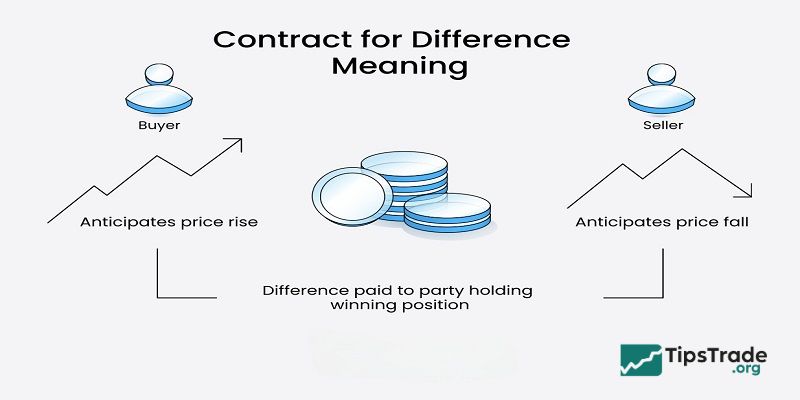
CFD stands for “Contract for Difference.” It is a type of derivative trading agreement between two parties (a buyer and a seller) based on the price movements of an underlying asset. With CFDs, investors can profit from price differences without directly owning the asset itself. You can open a buy position if you expect the price to rise, or open a sell position if you anticipate the price will fall.
- Example of CFD trading: Suppose you predict that the price of Apple stock will increase in the future. Instead of purchasing the stock directly, you open a CFD buy position on Apple shares. If the price of Apple stock rises as expected, you will earn a profit from the difference between the opening and closing prices of your position. Conversely, if the price of Apple stock declines, you will incur a loss.
See more:
- How to Place a CFD Order in 5 Steps for Beginners
- Is CFD difficult to learn for beginners? The Truth Explained
- Explore the Top 10 best CFD brokers for maximum profit
- CFD Demo Account: An Essential Tool for Beginner Traders
Types of assets that can be traded with CFDs
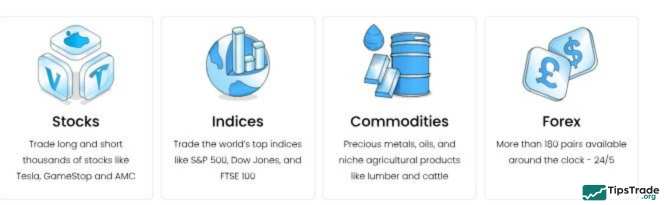
Below are some of the asset classes available for CFD trading guide that investors can choose from:
- Stocks: Trade price movements of shares without actually owning them, including major companies listed on exchanges such as the NASDAQ and the New York Stock Exchange.
- Indices: Stock market indices such as the S&P 500, the Dow Jones Industrial Average, and the NASDAQ Composite.
- Commodities: Precious metals and energy products such as gold, oil, and silver.
- Currencies: Trade currency pairs such as EUR/USD, GBP/USD, and USD/JPY.
- Cryptocurrencies: Popular digital currencies such as Bitcoin, Ethereum, and Solana.
Note: CFD contracts are widely used to trade various asset classes, including exchange-traded funds (ETFs). The number of tradable assets depends on the specific broker or trading platform.
See more:
- Stock CFDs: What is it and How to Trade?
- CFD Forex: Why Do Investors Choose CFDs Instead of Direct Trading?
How does CFD trading work?
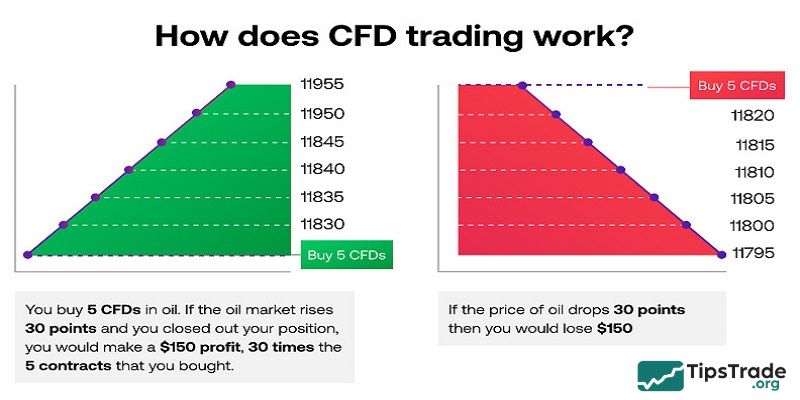
CFD trading guide operates based on the difference between the opening and closing prices of an asset. If you anticipate that the price will rise, you open a buy position; if you expect the price to fall, you open a sell position. Your profit or loss is calculated based on the price difference multiplied by the trade size.
In addition, CFDs involve the use of leverage, which can amplify potential profits but also increase the level of potential losses.
When understanding how CFDs work, investors should also be familiar with the following key concepts:
- Spread: The difference between the bid (buy) price and the ask (sell) price.
- Commission: A fee charged when you execute a CFD trade.
- Trading volume (Lot): A unit that measures trade size; 1 standard lot typically equals 100,000 units of the underlying asset.
- Margin: The amount of money you need to deposit in order to open a trading position.
- Contract duration: CFD contracts do not have a fixed expiration date. You can hold a position as long as you maintain sufficient margin.
Pros and cons of CFD trading
CFD trading offers many attractive benefits, but it also involves significant risks. Below are some of the key advantages and disadvantages of trading CFDs:
Pros of CFD trading
- The ability to profit in both rising and falling markets.
- Access to leverage, allowing traders to increase potential returns with a position size much larger than their actual capital.
- The opportunity to trade a wide range of assets across multiple markets.
- No need to own the underlying asset.
Cons of CFD trading
- High risk due to the use of significant leverage.
- Highly volatile markets may lead to slippage and orders being executed at prices different from expectations.
- Not suitable for beginners or traders with limited experience.
- Requires time for research and analysis to make well-informed trading decisions.
Step-by-Step CFD trading guide for beginners
Below is a CFD trading guide with the basic steps to help you start trading CFDs effectively:
- Step 1 – Learn about CFDs: Understand what CFDs are, how they work, and the benefits and risks involved.
- Step 2 – Choose a reputable broker: Select a broker that is licensed by major financial authorities to ensure transparency and safety in your trading activities.
- Step 3 – Choose a trading asset: Determine the type of asset you want to trade, such as forex, stocks, gold, or indices.
- Step 4 – Open an account and deposit funds: Register for an account, complete the identity verification process, and deposit an amount that suits your financial capacity.
- Step 5 – Choose your position (buy or sell): Predict the market trend and select the appropriate position. You can open a buy position if you expect the price to rise or a sell position if you anticipate the price to fall.
- Step 6 – Place a trade: Set your trading parameters such as volume (lot size), leverage, stop-loss, and take-profit levels, then execute the order.
- Step 7 – Monitor and close the trade: Track market movements and close your position when your target is reached or when you decide to cut losses.

Is CFD trading legal and safe?
CFDs are not a scam; they are a legitimate financial instrument widely used around the world. However, to trade effectively, you need to clearly understand how this type of product works.
For example, in Vietnam, the CFD market mainly operates through international brokers and is not officially licensed domestically. This creates opportunities for certain individuals or organizations to take advantage of beginners’ lack of knowledge to commit fraud.
Financial losses often result from choosing an untrustworthy broker, lacking proper risk management skills, or being persuaded by advertisements that promise unrealistically high returns. Therefore, it is essential to conduct thorough research, select brokers regulated by reputable international authorities, and avoid investment offers with unclear origins.

Important notes when trading CFDs
To trade CFDs effectively and minimize risks, you should keep the following key points in mind:
- Although leverage can increase potential returns, it can also significantly amplify risks.
- Avoid trading based on emotions, rumors, or herd mentality, as this can lead to poor decision-making.
- Before trading with real money, practice on a demo account to better understand how the platform works and to improve your trading skills and reaction time.
- Carefully review all applicable fees, such as commissions, spreads, and overnight financing charges, to prevent them from impacting your actual profits.
- Always stay updated on economic news, macroeconomic data, and market movements to optimize your trading performance.
Final words
The article above contains all the content related to the topic CFD trading guide. As you have seen, CFD trading offers many opportunities but also carries significant risks. Therefore, before participating, you need to clearly understand what CFD trading is, its advantages and disadvantages, and how it works. Hopefully the information above will be useful for you.