

During the process of trading CFDs (Contracts for Difference), you will be required to pay a certain CFD cost. To better understand these CFD costs, refer to the following article for more detailed information!
Why do traders need to understand CFD cost?
CFD cost refers to all the fees and expenses that traders must pay when trading Contracts for Difference (CFDs). These costs may include spreads, commissions, overnight fees (swap), deposit and withdrawal charges, and account-related fees.
So, understanding CFD cost helps traders accurately evaluate the performance of their trading strategies. Seemingly small fees such as spreads or swap charges can accumulate over time and reduce overall profitability. Additionally, being aware of CFD cost enables traders to choose the right broker, optimize entry and exit points, and avoid common mistakes such as overtrading or holding positions longer than necessary.

See more:
- What is CFD? Contracts for Difference Explained for Beginners
- Top 6 Best CFD Indicator Tools Every Trader Should Know
- CFD Forex: Why Do Investors Choose CFDs Instead of Direct Trading?
- Compare CFDs and Stocks: Differences, Similarities, and Which to Choose?
Common types of CFD cost
Spread
Spread is the difference between the buying price (Ask) and the selling price (Bid) of a CFD instrument. It is the most common cost that every trader encounters. Spreads can be fixed or variable depending on the broker and market conditions. During periods of high liquidity, spreads are typically lower; however, during high volatility or low liquidity, spreads may widen significantly.
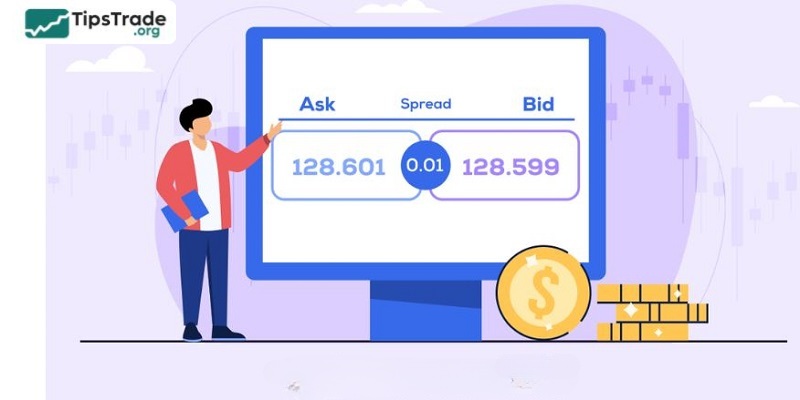
Suppose you want to go long on 100 lots of Stock A, which has a bid/ask of 1,200/1,198, so you stake $120,000. After a while, your speculation that the price will rise proves correct and the value of Stock A has increased to 1,225/1,223. You then sell your CFDs at the price of 1,223. for a profit of $122,300.
So, even though the price of the asset rose by 25 points, you would only get back 23 points worth of profit, as the spread took the rest. Notably, you would need the price of Stock A to rise by 2 points before you break even on your trade, thanks to the spread.
Commission
Some brokers, particularly those offering ECN or Raw Spread accounts, charge a commission per trade. Commission is usually calculated based on trading volume (lot size). Although traders pay an additional fee, spreads are typically much lower, which can benefit high-frequency traders or scalpers.

Suppose your broker takes a 0.1% commission per trade and you again wish to buy 100 lots for $120 per share. Your stake would again be $12,000 but the broker would take a 0.1% commission when you open the position, i.e. $12 (100 * $120 * 0.1%).
If the asset value rose to $130 per share and you decided to sell, you would initially get back $13,000 from the trade. However, you would have another round of commission charged at $13 (100 * $130 * 0.1%). So, even though the trade made $1,000, you will have paid a total of $25 commission, coming away with a net profit of $975.
Overnight Fee (Swap Fee)
Swap fees are charged when traders hold positions overnight. These fees depend on interest rate differentials (for Forex CFDs) or financing costs associated with the asset. If a position is held for several days or weeks, swap fees can become a significant portion of the total CFD cost and directly impact profitability.
For this example, consider that you have gone long on 1,000 lots of a CFD at a buy price of $4.50 and have not closed the position before the end of the trading day, at which point the price is $4.85.
Calculating the overnight financing rate is done as follows: (position size * closing price * [standard published rate + broker % value])/365. So, if the standard published rate is 2.5% and the broker % value is 2%, the holding fee for the above position would be (1,000 * $4.85 * [2.5% + 2%])/365 = $0.66.
Deposit, Withdrawal, and Account Fees
In addition to trading costs, traders should consider other potential expenses such as:
- Deposit and withdrawal fees
- Account maintenance fees
- Inactivity fees
- Currency conversion charges
These fees are often overlooked but can contribute significantly to overall trading expenses.
Factors that influence CFD cost
- Type of trading asset: Different CFD markets have varying cost structures. Forex CFDs generally offer lower spreads compared to crypto CFDs. Stock CFDs, on the other hand, may involve higher commissions but more stable spreads.
- CFD broker: Each broker operates under different business models such as ECN or Market Maker, which directly affect spreads, commissions, and other fees. Comparing brokers is therefore a crucial step in minimizing CFD cost.
- Market conditions: High volatility or major economic news can cause spreads to widen significantly. Similarly, low liquidity conditions can increase trading costs and affect order execution.
How to reduce CFD cost effectively
Choose a broker with competitive pricing
Traders should compare average spreads, commissions, and hidden fees before opening an account. A broker offering low spreads but high withdrawal fees may still result in higher overall CFD cost. When comparing CFD trading fees, you should consider the following factors:
- What sort of CFD trades will you be making? For example, if you are planning to trade stock/share CFDs, then the CFD fees relating to commissions would likely be more important than the spreads.
- What markets are you looking to trade in? It is common for different markets to have slightly different fees and prices. For example, UK stock CFDs usually handle commissions at a percentage level, whilst some US stock CFDs are charged at cents per share.
- Are you planning to hold positions open for more than a day? If you are not, then overnight holding fees are not likely to have an impact on your trades and could be less important to minimise.
>>See more: Explore the Top 10 best CFD brokers for maximum profit
Optimize your trading strategy
- Avoid trading during periods when spreads are excessively wide
- Limit long-term holding if swap fees are high
- Trade during high-liquidity sessions such as London or New York
Use the right account type
Scalpers may benefit from Raw Spread or ECN accounts, while long-term traders may prefer Standard accounts to reduce commission expenses.
Conclusion
That is all the information about the CFD cost that investors should consider before participating in trading activities. We hope this article has provided you with useful insights. Wishing you successful investments!