

Event-driven hedge funds are a specialized investment strategy that seeks to profit from corporate actions, mergers and acquisitions, restructurings, and other market-moving events. Unlike traditional equity investing, this approach focuses less on long-term fundamentals and more on how specific events can temporarily misprice securities. Terms such as event-driven investing, merger arbitrage, special situations, distressed securities, and corporate restructuring frequently appear in discussions around this strategy. Explore the detailed article at Tipstrade.org to be more confident when making important trading decisions.
What Are Event-Driven Hedge Funds?
Event-driven hedge funds are investment vehicles that attempt to generate returns by exploiting price inefficiencies caused by specific corporate or economic events. These events often include mergers, acquisitions, bankruptcies, spin-offs, share buybacks, or major regulatory changes.
From an industry perspective, event-driven strategies fall under the broader category of alternative investments, alongside global macro, long/short equity, and relative value strategies. According to data from Hedge Fund Research (HFR), event-driven funds have historically represented a significant portion of hedge fund assets due to their potential to perform independently of overall market direction.
What differentiates event-driven hedge funds is their focus on probability-weighted outcomes rather than broad market trends. Managers evaluate how likely an event is to occur and how the market might reprice assets once uncertainty is resolved. This makes the strategy particularly attractive during periods of elevated corporate activity or regulatory change.

See more
- Hedge Funds Report: A Comprehensive Analysis of Performance, Strategies, and Industry Trends
- Index Funds vs Mutual Funds: Understanding the Key Differences Before You Invest
- Top Index Funds to Consider for Long-Term Investing
- Risks in Index Funds: What Every Investor Should Understand
How Event-Driven Investing Works
At its core, event-driven investing is based on the idea that markets often misprice securities during periods of uncertainty. When a company announces a major corporate action, investors may react emotionally or lack complete information, leading to temporary inefficiencies.
Event-driven hedge fund managers typically:
- Identify an upcoming or ongoing corporate event
- Analyze legal, financial, and regulatory factors
- Estimate potential outcomes and probabilities
- Structure positions to benefit if the expected outcome materializes
For example, during a merger announcement, the target company’s stock may trade below the acquisition price due to deal completion risk. Event-driven funds attempt to profit from this spread once the transaction closes.
Academic research published in journals such as The Journal of Finance has shown that event-related mispricings can persist long enough for skilled managers to exploit, particularly when the event is complex or controversial.
Key Strategies Used by Event-Driven Hedge Funds
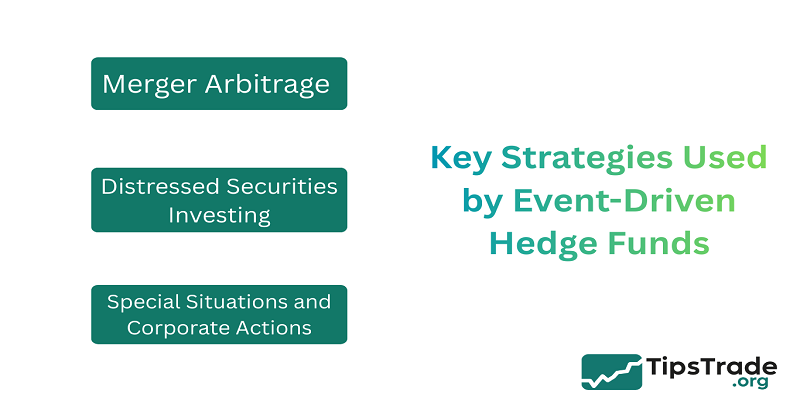
Merger Arbitrage (Risk Arbitrage)
- Merger arbitrage is one of the most common event-driven strategies. It involves buying shares of a target company after a merger announcement while sometimes shorting the acquiring company’s stock.
- The goal is to capture the spread between the current market price and the announced acquisition price. According to data from Bloomberg, merger arbitrage spreads typically widen when regulatory or financing risks increase.
- However, this strategy carries notable risks. Deals may be delayed, restructured, or canceled entirely.
- For example, high-profile failed mergers due to antitrust concerns have historically caused significant losses for funds overly concentrated in a single transaction. As a result, professional managers emphasize diversification and legal analysis.
Distressed Securities Investing
- Distressed securities strategies focus on companies experiencing financial distress, bankruptcy, or restructuring. Securities may trade at deep discounts due to uncertainty, legal proceedings, or liquidity concerns.
- Event-driven hedge funds analyze balance sheets, capital structures, and bankruptcy laws to determine whether recovery values exceed current prices. According to research from Moody’s and academic studies, recovery rates in distressed debt vary significantly depending on seniority and economic conditions.
- This strategy requires specialized expertise, as outcomes depend heavily on court decisions, negotiations with creditors, and restructuring plans. While returns can be substantial, losses can also be severe if recovery assumptions prove incorrect.
Special Situations and Corporate Actions
- Special situations investing includes events such as spin-offs, share repurchases, asset sales, or management changes. These events can cause temporary mispricing due to forced selling, index rebalancing, or limited analyst coverage.
- For instance, studies published by the CFA Institute suggest that spin-offs have historically outperformed parent companies in the years following separation, partly due to improved management focus and investor revaluation.
- Event-driven hedge funds capitalize on these inefficiencies by conducting deep fundamental research and anticipating how investor perception may change once the event is completed.
How Event-Driven Hedge Funds Generate Returns
Event-driven hedge funds aim to generate risk-adjusted returns that are less correlated with traditional equity markets. Instead of relying on market appreciation, returns come from:
- Deal completion
- Resolution of uncertainty
- Legal or regulatory outcomes
- Market repricing after corporate events
According to HFR indices, event-driven strategies have historically shown moderate correlation with equity markets but tend to outperform during periods of stable or rising corporate activity. However, returns can be volatile during market stress when deal financing becomes constrained.
Managers often hold positions for weeks or months rather than years, making event-driven investing a medium-term strategy compared to traditional buy-and-hold investing.
Risks Associated With Event-Driven Hedge Funds

Despite their appeal, event-driven hedge funds carry significant risks. One of the primary risks is event failure, where anticipated outcomes do not materialize. Regulatory intervention, financing issues, or shareholder opposition can derail even well-structured deals.
Other risks include:
- Legal and regulatory uncertainty
- Liquidity risk in distressed assets
- Concentration risk in specific events
- Sudden market volatility
According to the U.S. Securities and Exchange Commission (SEC), alternative investment strategies such as hedge funds require careful due diligence due to their complexity and potential for loss. Investors should be aware that past performance does not guarantee future results.
When Event-Driven Strategies Underperform
Event-driven strategies may struggle during periods of extreme market stress, such as financial crises or sudden interest rate shocks. During these times, deal activity often slows, and financing becomes scarce.
Research from the Federal Reserve suggests that tightening credit conditions can significantly reduce merger activity, limiting opportunities for event-driven funds. In such environments, managers may face wider spreads and higher downside risk.
Who Should Consider Event-Driven Hedge Funds?
Event-driven hedge funds are typically suitable for:
- Institutional investors
- Accredited investors
- Portfolios seeking diversification from traditional assets
These strategies may not be appropriate for retail investors with low risk tolerance or short investment horizons. Liquidity constraints, lock-up periods, and complex fee structures can further limit accessibility.
Professional advisors often recommend event-driven exposure as a satellite allocation rather than a core holding within a diversified portfolio.
Comparison With Other Hedge Fund Strategies
| Feature | Event-Driven | Global Macro | Long/Short Equity |
| Market Dependence | Medium | High | Medium |
| Time Horizon | Medium-term | Short to medium | Medium to long |
| Main Risk | Event failure | Macro misjudgment | Stock selection |
| Skill Focus | Legal & deal analysis | Economic forecasting | Fundamental analysis |
This comparison highlights why investors often view event-driven hedge funds as a hybrid strategy, combining elements of fundamental and tactical investing.
Historical Performance of Event-Driven Hedge Funds
Historical data from Hedge Fund Research indicates that event-driven strategies have delivered competitive returns over long periods, particularly during economic expansions marked by active M&A markets.
However, performance dispersion is wide. Top-performing funds significantly outperform average peers, while poorly managed funds may underperform traditional benchmarks. This emphasizes the importance of manager selection and risk management.
Conclusion
Event-driven hedge funds represent a sophisticated investment approach centered on corporate events and market inefficiencies. By focusing on mergers, restructurings, and special situations, these funds seek returns that are less dependent on overall market direction. While the strategy offers diversification and unique opportunities, it also involves meaningful risks that require expertise, disciplined analysis, and strong risk management. For investors seeking a deeper understanding of alternative investments, event-driven hedge funds remain an important and influential segment of the hedge fund industry.