
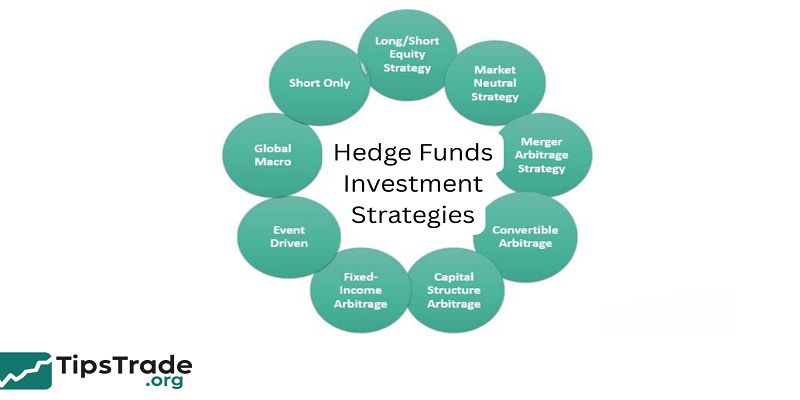
Hedge funds investment strategies play a critical role in modern financial markets, offering sophisticated approaches to portfolio diversification, risk-adjusted returns, and alpha generation. Unlike traditional investment vehicles, hedge funds rely on flexible trading strategies, active risk management, and advanced financial instruments to navigate bull markets, bear markets, and periods of economic uncertainty. Investors searching for information about hedge fund strategies often want to understand how hedge funds make money, what risks are involved, and why these strategies differ from mutual funds or ETFs. Explore the detailed article at Tipstrade.org to be more confident when making important trading decisions.
How Hedge Funds Use Investment Strategies Differently Than Traditional Funds
Hedge funds differ fundamentally from traditional investment funds because of their structural flexibility and strategic freedom. While mutual funds and ETFs are often constrained by regulatory requirements, benchmark tracking, and long-only mandates, hedge funds can freely use short selling, leverage, derivatives, and alternative assets. This flexibility allows hedge fund managers to pursue absolute returns rather than relative performance against an index.
In practice, hedge fund investment strategies are designed to exploit market inefficiencies, mispriced securities, and macroeconomic trends. Managers actively adjust exposure based on volatility, liquidity, and correlation between asset classes.
For example, during periods of rising interest rates, hedge funds may reduce equity exposure while increasing positions in currencies or fixed income derivatives.
Academic research published by institutions such as the CFA Institute highlights that hedge fund strategies often aim to deliver lower correlation to traditional assets, making them attractive for portfolio diversification.
However, this freedom also introduces higher complexity and requires advanced risk controls to protect capital.

What Makes Hedge Fund Investment Strategies Unique?
Flexibility, Leverage, and Absolute Return Focus
- One defining feature of hedge fund investment strategies is their absolute return objective. Rather than outperforming a benchmark like the S&P 500, hedge funds seek to generate positive returns regardless of market direction.
- This is achieved through flexible positioning, including long and short exposure within the same portfolio.
- Leverage is another distinctive element. Hedge funds may borrow capital to amplify returns, especially in low-volatility environments. According to data from the U.S.
- Securities and Exchange Commission (SEC), leverage can significantly enhance performance but also magnify losses if risk is poorly managed. As a result, professional hedge funds implement strict margin controls, stress testing, and scenario analysis.
- Flexibility extends beyond equities. Hedge fund managers actively trade commodities, currencies, credit instruments, and structured products.
- This multi-asset approach allows them to respond quickly to macroeconomic shifts, geopolitical risks, and central bank policy changes.

Hedge Funds vs Mutual Funds vs ETFs
Structural and Strategic Differences
Understanding hedge fund investment strategies requires comparing them with traditional investment vehicles. Mutual funds typically follow long-only strategies and must maintain high liquidity to meet daily redemptions. ETFs are designed to track indices passively, prioritizing low cost and transparency over active alpha generation.
Hedge funds, by contrast, operate with fewer constraints. They can lock up investor capital for longer periods, enabling managers to hold complex or illiquid positions. According to research from Morningstar and academic journals, hedge funds often demonstrate greater return dispersion, meaning outcomes depend heavily on manager skill.
| Feature | Hedge Funds | Mutual Funds | ETFs |
| Investment Goal | Absolute returns | Relative returns | Index tracking |
| Short Selling | Allowed | Limited | Rare |
| Leverage | Common | Restricted | Minimal |
| Liquidity | Limited | Daily | Daily |
This comparison highlights why hedge fund strategies appeal to sophisticated investors seeking diversification beyond traditional assets.
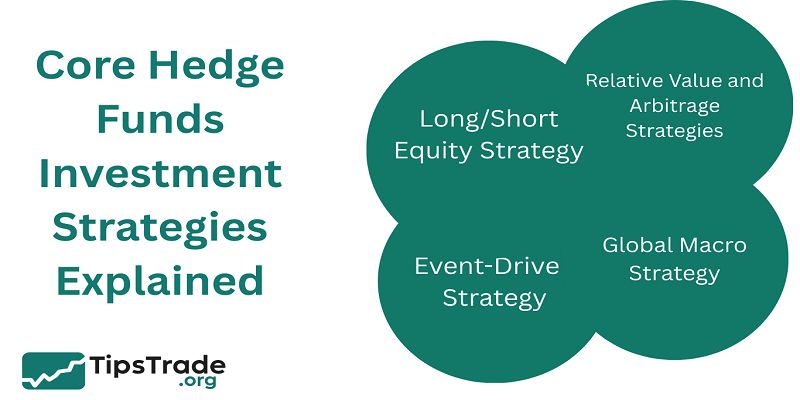
Core Hedge Funds Investment Strategies Explained
Long/Short Equity Strategy
The long/short equity strategy is one of the most widely used hedge fund investment strategies. Managers take long positions in undervalued stocks while simultaneously shorting overvalued securities. This structure aims to reduce overall market exposure while capturing stock-specific alpha.
In practice, long/short equity funds rely heavily on fundamental analysis, including financial statements, industry trends, and corporate governance. According to studies by Harvard Business School, successful long/short managers often demonstrate strong stock-picking skills rather than market timing ability.
Risk management is central to this strategy. Position sizing, sector neutrality, and stop-loss mechanisms help mitigate downside risk. While long/short equity funds can perform well in volatile markets, they may underperform during strong bull markets when short positions detract from returns.
Global Macro Strategy
Global macro hedge fund investment strategies focus on macroeconomic trends such as interest rates, inflation, currency movements, and geopolitical events. Managers analyze economic indicators, central bank policies, and fiscal developments to position across global markets.
For example, during tightening monetary cycles, global macro funds may short government bonds or take long positions in currencies expected to appreciate. Research from the Bank for International Settlements shows that macro strategies often benefit from increased market volatility.
However, these strategies carry significant risk. Incorrect macro assumptions or unexpected policy shifts can result in rapid losses. As a result, experienced macro hedge funds rely on scenario analysis, diversification across regions, and dynamic hedging to manage uncertainty.
Event-Driven Strategy
Event-driven hedge fund investment strategies seek to profit from corporate events such as mergers, acquisitions, restructurings, and bankruptcies. These strategies assume that markets temporarily misprice securities during periods of uncertainty.
Merger arbitrage, a common event-driven approach, involves buying shares of a target company while shorting the acquiring firm. Academic research published in the Journal of Finance suggests that merger arbitrage returns are relatively stable but sensitive to deal completion risk.
Event-driven strategies require deep legal and financial expertise. Managers must evaluate regulatory risks, financing conditions, and deal structures. While returns can be attractive, unexpected deal cancellations can lead to sharp losses.
Relative Value and Arbitrage Strategies
Relative value hedge fund strategies exploit pricing inefficiencies between related securities. Examples include fixed income arbitrage, convertible bond arbitrage, and statistical arbitrage.
These strategies often rely on quantitative models and leverage to amplify small price discrepancies. According to research from the Federal Reserve, relative value strategies tend to perform well in stable markets but may suffer during liquidity crises.
Because leverage is common, robust risk management is essential. Hedge funds use margin controls, diversification, and real-time monitoring to manage exposure. While relative value strategies may deliver consistent returns, they are vulnerable to systemic shocks.
Multi-Strategy Hedge Funds and Portfolio Construction

Combining Multiple Hedge Fund Strategies
Multi-strategy hedge funds allocate capital across several investment approaches to reduce volatility and enhance risk-adjusted returns. By combining long/short equity, macro, and arbitrage strategies, managers aim to diversify sources of alpha.
Empirical studies by institutional research firms such as Preqin indicate that multi-strategy funds often exhibit lower drawdowns compared to single-strategy funds. Capital is dynamically reallocated based on market conditions and performance metrics.
This structure requires sophisticated infrastructure, including centralized risk management systems and cross-strategy oversight. While multi-strategy funds may offer more stable returns, they also demand higher fees and operational complexity.
Strategy Rotation Across Market Cycles
Hedge fund investment strategies are not static. Managers rotate strategies depending on economic cycles, volatility regimes, and liquidity conditions. During bull markets, equity-focused strategies may dominate. In contrast, macro and relative value strategies may perform better during downturns.
Historical analysis from the International Monetary Fund shows that adaptive strategy rotation can significantly improve long-term performance. However, timing errors and overconfidence can reduce returns. Successful hedge funds balance quantitative signals with qualitative judgment to guide strategy shifts.
Risk Management in Hedge Funds Investment Strategies
Risk Control Tools Used by Hedge Funds
Risk management is a cornerstone of hedge fund investment strategies. Common tools include hedging, value-at-risk (VaR) models, stress testing, and stop-loss limits. These mechanisms help managers understand potential losses under adverse scenarios.
According to the CFA Institute, hedge funds that invest heavily in risk analytics tend to exhibit lower volatility and drawdowns. Real-time monitoring allows managers to respond quickly to market shocks, reducing the likelihood of catastrophic losses.
Key Risks Investors Should Understand
Despite advanced controls, hedge fund strategies involve several risks. Leverage risk can amplify losses, while liquidity risk may prevent timely exit from positions. Manager risk is also significant, as performance depends heavily on decision-making quality.
Transparency is another concern. Unlike mutual funds, hedge funds disclose limited information. Investors must rely on due diligence, audited reports, and third-party oversight to assess risk accurately.

How to Evaluate a Hedge Fund’s Investment Strategy
Performance Metrics That Matter
Evaluating hedge fund investment strategies requires more than headline returns. Metrics such as alpha, Sharpe ratio, and maximum drawdown provide deeper insight into risk-adjusted performance.
Academic research consistently shows that high returns accompanied by excessive volatility are less desirable than moderate, stable performance. Investors should assess whether returns are driven by skill or market exposure.
Questions Investors Should Ask Before Investing
Before allocating capital, investors should ask critical questions: Is the strategy consistent with current market conditions? How experienced is the management team? What risk controls are in place?
Due diligence reports from institutional consultants emphasize that understanding strategy logic is essential to long-term success. Investors should avoid strategies they do not fully understand.
Conclusion
Hedge funds investment strategies offer a unique approach to generating alpha through flexibility, active risk management, and diversified sources of return. Unlike traditional funds, hedge funds can adapt quickly to changing market environments, making them valuable tools for sophisticated investors seeking diversification. However, these strategies also carry higher complexity and risk, requiring careful evaluation and due diligence. By understanding how hedge fund strategies work, investors can make more informed decisions and better assess whether these approaches align with their financial goals and risk tolerance.