

Global Macro Hedge Funds represent one of the most dynamic and influential strategies in the investment world, betting on broad economic trends across currencies, commodities, bonds, and equities. These funds, pioneered by legends like George Soros and managed by firms such as Bridgewater Associates, thrive by anticipating macroeconomic shifts—think interest rate changes, geopolitical events, or inflation surges—rather than focusing on individual stocks. Unlike traditional investments, they offer portfolio diversification through global opportunities, but they demand sophisticated risk management amid high volatility. Explore the detailed article at Tipstrade.org to be more confident when making important trading decisions.
What Are Global Macro Hedge Funds?
Global Macro Hedge Funds are investment funds that seek to profit from large-scale economic and political trends across global markets. Rather than focusing on individual companies or sectors, these funds analyze macroeconomic variables such as interest rates, inflation, currency movements, fiscal policy, and geopolitical developments. Their core philosophy is simple: when global economic conditions shift, asset prices across countries and asset classes tend to move together in predictable ways.
In practice, Global Macro Hedge Funds operate with a top-down investment approach. Portfolio managers start by forming a view on the global economy—such as whether inflation is accelerating, whether central banks are tightening monetary policy, or whether global growth is slowing. Based on these views, they position capital across asset classes including equities, bonds, currencies (FX), commodities, and derivatives.
From an investor’s perspective, Global Macro Hedge Funds are often viewed as flexible and opportunistic. They can go long or short, use leverage, and rapidly adjust exposure when macro conditions change. This adaptability is one reason Global Macro funds gained prominence during periods of high volatility, such as inflationary cycles, financial crises, or major policy shifts by central banks like the Federal Reserve or the European Central Bank.
See more
- Hedge Funds Report: A Comprehensive Analysis of Performance, Strategies, and Industry Trends
- Index Funds vs Mutual Funds: Understanding the Key Differences Before You Invest
- Top Index Funds to Consider for Long-Term Investing
- Risks in Index Funds: What Every Investor Should Understand
How Global Macro Hedge Funds Work
Macro Themes and Economic Cycles
- At the heart of Global Macro Hedge Funds lies the identification of macro themes that play out over months or years. These themes are closely tied to economic cycles, which typically move through phases of expansion, peak, contraction, and recovery. Global Macro managers aim to anticipate these shifts earlier than the broader market.
- For example, during an economic expansion, macro investors may expect rising inflation and tighter monetary policy. This could lead to short positions in government bonds and long positions in inflation-sensitive assets such as commodities. Conversely, during economic slowdowns, Global Macro funds might increase exposure to safe-haven assets like U.S. Treasuries or the Japanese yen.
- Professional Global Macro managers rely heavily on economic indicators such as GDP growth, inflation expectations, employment data, yield curves, and central bank guidance. Institutions like the IMF, World Bank, and BIS frequently provide data that shapes macro outlooks.
- Experienced funds combine this data with qualitative judgment, recognizing that markets often move ahead of official economic releases.
Asset Classes Used in Global Macro Investing
Global Macro Hedge Funds are not restricted to a single asset class. Their strength lies in diversification across global markets, allowing them to express macro views in the most efficient instruments available.
Common asset classes include:
- Equities: Index futures or ETFs representing entire markets or regions
- Fixed Income: Government bonds, interest rate swaps, and yield curve trades
- Currencies (FX): Major and emerging market currency pairs
- Commodities: Energy, metals, and agricultural products
- Derivatives: Options and futures to manage risk or enhance returns
This flexibility allows Global Macro funds to shift capital dynamically, choosing the asset class that best reflects a given macro thesis while managing downside risk.
Core Global Macro Strategies
Discretionary Global Macro
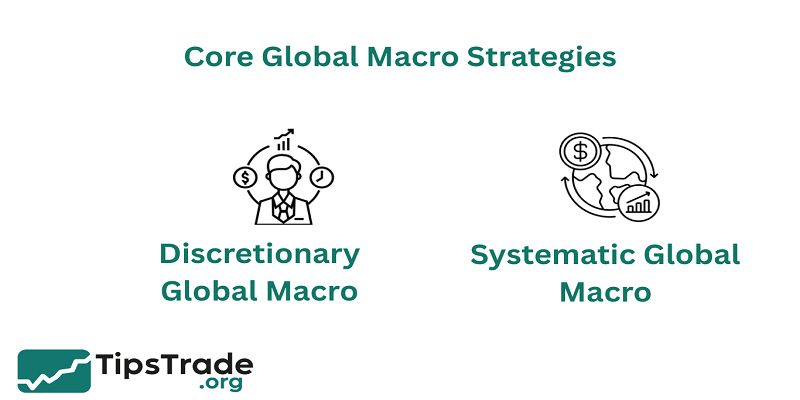
- Discretionary Global Macro strategies rely primarily on human judgment. Portfolio managers and research teams analyze economic data, policy developments, and geopolitical events to form macro views. These views are then translated into investment positions.
- In discretionary macro funds, experience plays a critical role. Many successful managers have decades of exposure to different economic regimes, allowing them to recognize patterns that quantitative models may overlook.
- For instance, during sudden policy reversals or geopolitical crises, discretionary managers may act faster than systematic strategies.
- However, discretionary approaches also carry behavioral risks. Cognitive biases, overconfidence, or misinterpretation of data can negatively affect performance.
- As a result, top-tier discretionary Global Macro funds often emphasize rigorous risk management and internal debate to challenge dominant narratives.
Systematic Global Macro
- Systematic Global Macro strategies rely on quantitative models and algorithms rather than discretionary judgment. These models analyze large datasets to identify statistical relationships between macro variables and asset prices.
- Systematic macro funds often use signals derived from momentum, trend-following, valuation, or macroeconomic indicators. Trades are executed automatically based on predefined rules, reducing emotional bias and increasing consistency.
- One advantage of systematic strategies is scalability. Models can process vast amounts of data across multiple markets simultaneously. However, they may struggle during regime changes when historical relationships break down.
- As a result, many large Global Macro funds blend discretionary oversight with systematic frameworks to balance adaptability and discipline.
How Global Macro Hedge Funds Make Money
Global Macro Hedge Funds generate returns by correctly anticipating macroeconomic shifts and positioning portfolios accordingly. Unlike traditional long-only strategies, they can profit in both rising and falling markets.
For example, if a fund expects central banks to raise interest rates aggressively, it may short government bonds or enter interest rate swap positions. If the thesis proves correct and yields rise, the fund profits. Similarly, a bullish outlook on commodities driven by inflation or supply constraints can lead to long positions in oil or metals futures.
Currency markets also play a significant role. Global Macro funds frequently trade FX based on interest rate differentials, capital flows, and geopolitical risk. During periods of global uncertainty, capital often flows into perceived safe-haven currencies, creating opportunities for macro-driven FX trades.
Importantly, leverage is commonly used to amplify returns. While leverage increases potential profits, it also magnifies losses, making risk management a central pillar of Global Macro investing.
Risk Management in Global Macro Funds

Risk management is arguably the most critical component of Global Macro Hedge Funds. Given their exposure to volatile global markets and use of leverage, unmanaged risk can quickly erode capital.
Professional Global Macro funds employ multiple layers of risk controls, including position limits, stop-loss mechanisms, and scenario analysis. Stress testing is commonly used to evaluate how portfolios might perform under extreme market conditions, such as sudden interest rate shocks or geopolitical escalations.
Diversification across asset classes, regions, and strategies also helps mitigate risk. By avoiding excessive concentration in a single macro theme, funds aim to reduce drawdowns during adverse market movements.
Additionally, liquidity management is essential. Global Macro funds typically favor highly liquid instruments, enabling them to adjust positions quickly when macro conditions change unexpectedly.
Advantages and Challenges of Global Macro Hedge Funds
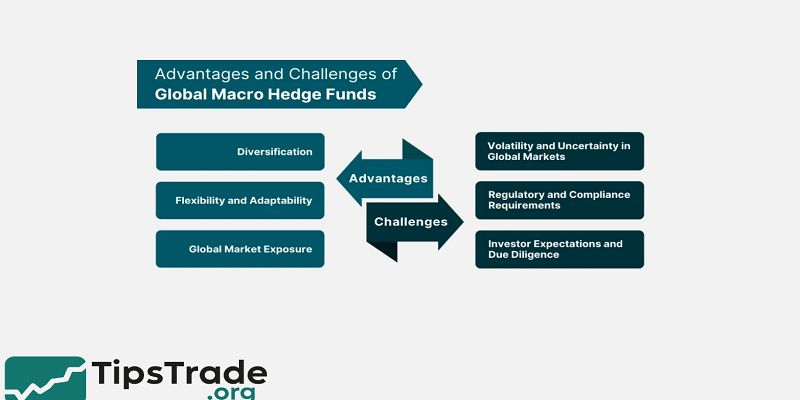
Global Macro Hedge Funds offer several compelling advantages, particularly for investors seeking diversification beyond traditional assets. Their ability to profit across market cycles and asset classes makes them attractive during uncertain economic environments.
Advantages include:
- Flexibility to go long or short across global markets
- Potential to perform well during periods of volatility
- Diversification benefits relative to equity-heavy portfolios
- Access to sophisticated macro research and expertise
However, these benefits come with notable drawbacks.
Challenges include:
- High fees compared to traditional investment funds
- Complexity and lack of transparency for retail investors
- Performance dispersion between top and average managers
- Potential for large drawdowns if macro views are incorrect
Understanding these trade-offs is essential before considering exposure to Global Macro strategies.
Global Macro vs Other Hedge Fund Strategies
| Strategy Type | Core Focus | Asset Classes | Risk Profile |
| Global Macro | Macroeconomic trends | Multi-asset | Medium to High |
| Equity Long/Short | Company fundamentals | Equities | Medium |
| CTA / Managed Futures | Trend-following | Futures | Medium |
| Event-Driven | Corporate events | Equities & Credit | Medium |
Compared to other hedge fund strategies, Global Macro stands out for its top-down approach and broad investment universe. While CTAs focus more on price trends, Global Macro funds incorporate fundamental macro analysis to guide positioning.
Famous Global Macro Hedge Funds and Case Studies
Some of the most influential hedge funds in history have employed Global Macro strategies. Bridgewater Associates, founded by Ray Dalio, is often cited as the world’s largest Global Macro hedge fund. Bridgewater’s “Pure Alpha” strategy is built around systematic macro principles that aim to perform across different economic environments.
Brevan Howard is another prominent example, known for its discretionary macro expertise, particularly in interest rate and FX markets. The fund gained recognition for navigating complex monetary policy shifts during periods of global financial stress.
These case studies highlight a common theme: successful Global Macro funds invest heavily in research, risk management, and talent. Performance is often driven less by individual trades and more by a coherent framework for understanding global economic dynamics.
Who Should Consider Global Macro Hedge Funds?
Global Macro Hedge Funds are generally suited for institutional investors, family offices, and high-net-worth individuals who can tolerate complexity and volatility. Their minimum investment requirements and fee structures often place them out of reach for most retail investors.
From a portfolio construction perspective, Global Macro funds may appeal to investors seeking diversification away from equity-centric strategies. During periods of rising inflation, geopolitical uncertainty, or monetary tightening, macro strategies may provide uncorrelated returns.
However, they are not a universal solution. Investors with low risk tolerance or limited understanding of macroeconomic dynamics may find Global Macro strategies challenging to evaluate and monitor.
The Role of Global Macro Funds in a Diversified Portfolio
In a diversified portfolio, Global Macro Hedge Funds can serve as a complementary allocation rather than a core holding. Their returns often exhibit low correlation with traditional stocks and bonds, particularly during market stress.
Institutional portfolios frequently allocate a modest percentage to Global Macro strategies as part of an alternatives bucket. This allocation aims to enhance risk-adjusted returns while providing potential downside protection during economic shocks.
That said, timing and manager selection are critical. Poorly chosen macro funds can increase portfolio volatility rather than reduce it, underscoring the importance of due diligence.
Current Trends and the Future of Global Macro Investing
The global macro landscape continues to evolve. Persistent inflation, shifting monetary regimes, and increasing geopolitical fragmentation have renewed interest in macro-driven strategies. Central banks are navigating complex trade-offs between growth and price stability, creating fertile ground for macro opportunities.
At the same time, advances in data analytics and artificial intelligence are reshaping systematic macro strategies. Funds are increasingly integrating alternative data sources to gain an informational edge.
Looking ahead, Global Macro Hedge Funds are likely to remain relevant as long as global economic uncertainty persists. Their success, however, will depend on adaptability and disciplined risk management in an ever-changing macro environment.

Conclusion
Global Macro Hedge Funds stand out as powerful tools for navigating an increasingly interconnected and unpredictable global economy, delivering alpha through prescient bets on macroeconomic forces. While their flexibility and potential for outsized returns make them attractive to sophisticated investors, success hinges on disciplined strategy and robust risk controls amid market turbulence.