
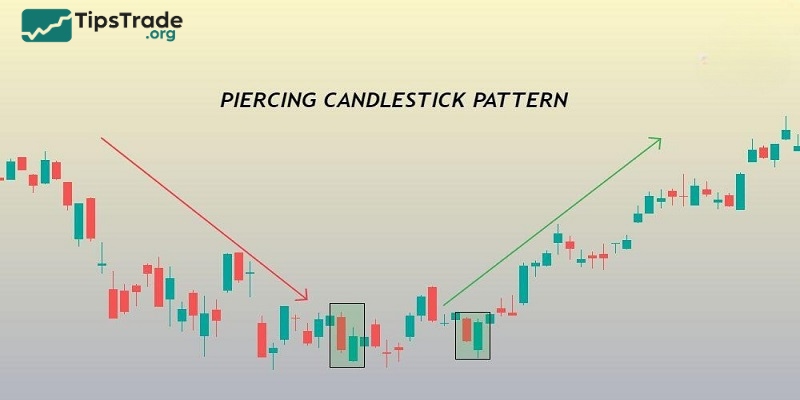
The piercing candlestick pattern is one of the most popular patterns in trading. Let’s explore more about what the piercing candlestick pattern is and how to trade it effectively in the article below!
What is the piercing candlestick pattern?
The piercing candlestick pattern is one of the potential short-term price reversal patterns, signaling a shift from a downtrend to an uptrend. This pattern typically appears at the bottom of a downtrend and indicates a possible reversal of the prevailing trend.
The piercing pattern consists of two candlesticks: the first is a bearish candle and the second is a bullish candle. The bearish candle usually has a long body, representing strong control by sellers. The bullish candle opens below the bearish candle and closes above the midpoint of the bearish candle’s body.
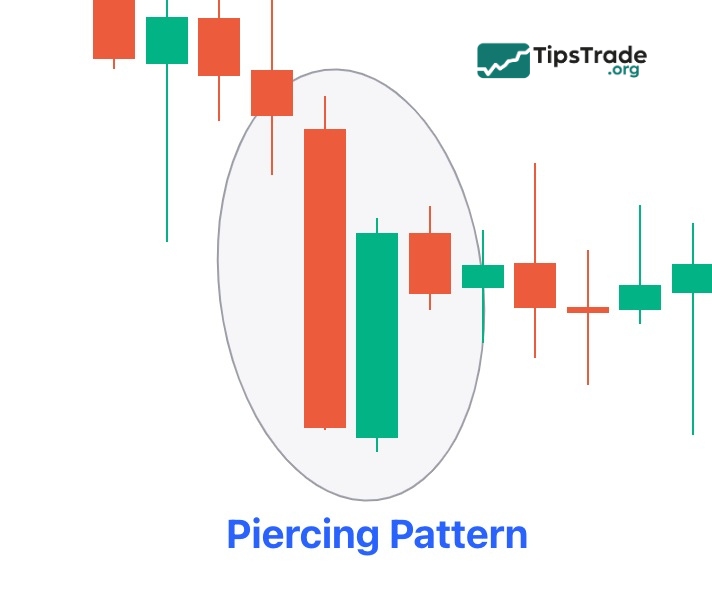
The piercing pattern suggests a weakening of selling pressure in the market and a strengthening of buying momentum. When properly confirmed, this pattern can be a strong reversal signal and may indicate the beginning of a new uptrend.
However, investors should take other factors into consideration when making trading decisions, rather than relying solely on a single candlestick pattern.
Related posts:
- Spinning Top Candlestick and How to Apply It in Technical Analysis
- How to Use the Hammer Candlestick for the Most Effective Trading
- Shooting Star Candlestick Pattern: How to Identify and Trade It Effectively
- What is a Doji candlestick pattern? Common Doji candlestick patterns in investing
Market psychology behind the piercing candlestick pattern
Basically, the piercing candlestick pattern reflects the opposition between buying and selling forces in the market. In general, the piercing pattern is formed through the following two psychological developments:
When the market shows signs of decline and continues to fall sharply, sellers take advantage of this momentum to create a long-bodied bearish candle and push prices down to a new area, putting buyers in a passive position. However, near the market close, a significant movement may occur that causes the market to suddenly reverse. At this point, the market rejects the previous price level, allowing buyers to regain control.
When the piercing candlestick pattern appears, traders who were previously on the sidelines begin to feel cautious and question whether selling pressure is still strong enough to sustain the downtrend. Meanwhile, investors who had entered short positions earlier may become confused as prices suddenly move upward, resulting in losses.
Key characteristics of the piercing candlestick pattern
The piercing candlestick pattern is a reversal signal that indicates a shift from a downtrend to an uptrend in the exchange rates of currency pairs in Forex and Binary Options trading. Traders can identify the characteristics of the Piercing Pattern through the following factors:
- The piercing candlestick pattern typically appears at the end of a downtrend.
- The piercing candlestick pattern consists of two consecutive candlesticks.
- The first candlestick is a large bearish candle, while the second is a bullish candle with a body length of at least 50% of the first candle’s body.
- The first and second candlesticks should have sizes comparable to the preceding candlesticks (within the previous 10-15 candles).

Note: For piercing pattern formations that are too small or unclear, traders should avoid entering trades, as such signals are too weak. These formations may not truly represent a piercing pattern; instead, they may simply reflect market indecision while selling pressure still dominates the market.
How to trade the piercing candlestick pattern effectively
Entry strategy
- Conservative Entry (Recommended): Wait for confirmation on the third candle. Enter a long position when price breaks above the high of the bullish (second) candle. This confirmation reduces false signals but may result in a slightly higher entry price.
- Aggressive Entry: Enter immediately at the close of the second candle or on the opening of the third candle. This approach maximizes potential profit but increases risk of false breakouts.
Stop-loss placement
Position your stop loss just below the low of the piercing pattern (typically the low of the second candle). This placement:
- Defines clear risk parameters
- Protects capital if the reversal fails
- Allows the trade room to develop without premature exits
Profit target setting
- Target 1 (Conservative): First significant resistance level or 1.5-2 times your risk (1.5:1 to 2:1 risk-reward ratio)
- Target 2 (Moderate): Previous swing high or major resistance zone
- Target 3 (Aggressive): Use trailing stops after achieving initial targets to capture extended moves
Risk management guidelines
- Never risk more than 1-2% of your trading capital on a single trade
- Use position sizing that keeps your stop loss within your risk tolerance
- Consider partial profit-taking at predetermined levels
- Adjust stops to breakeven once the trade moves favorably
Real-world example of how to trade with the piercing candlestick pattern
Let’s examine a real-world application using Nifty 50 daily chart:
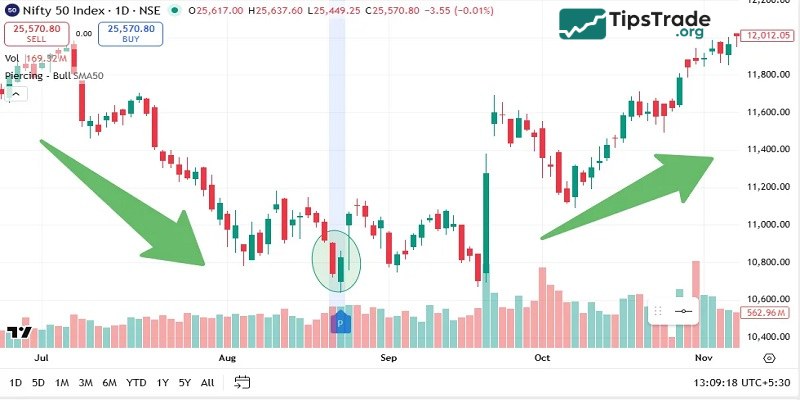
Setup:
- Stock was in a clear downtrend for several weeks
- A long red candle formed, continuing the bearish momentum
- The next day opened with a gap down but rallied strongly
- The bullish candle closed at approximately 65% of the previous candle’s body
- Volume was 35% higher than the 20-day average
- Pattern formed near a key support level at ₹10,600
Outcome: The stock reached Target 1 within five trading sessions and Target 2 within three weeks, demonstrating the pattern’s effectiveness when properly identified and traded.
Pros and cons of the piercing candlestick pattern
Pros:
- Occurs frequently in financial markets
- Offers opportunities for a favorable risk–reward ratio
- The piercing candlestick pattern is easy to identify, especially for beginner traders
Cons:
- The piercing candlestick pattern only signals bullish reversals.
- Trading with the piercing candlestick pattern requires the use of technical indicators and oscillators.
- Traders should consider the overall market trend rather than relying solely on a single candlestick pattern.
Above, we have shared all the basic knowledge about the piercing candlestick pattern. This is a relatively useful pattern that traders can refer to and apply along with the technical analysis methods mentioned above to achieve more effective investment results.
See more: