

Mutual funds reports are essential tools for investors who want to make informed decisions and monitor their investment performance. These reports provide a detailed snapshot of a fund’s portfolio, including Net Asset Value (NAV), fund performance, expense ratios, holdings, sector allocation, benchmark comparisons, and risk metrics. This guide explains all critical components of a mutual funds report, provides tips for interpretation, and offers practical examples to help investors make data-driven decisions. Explore the detailed article at Tipstrade.org to be more confident when making important trading decisions.
What is a Mutual Funds Report?
Definition and Purpose
A mutual funds report is a structured document that summarizes the performance and characteristics of a mutual fund over a specific period. The report is usually generated by the fund company monthly, quarterly, or annually, and is designed to provide transparency to investors regarding portfolio management, returns, and expenses.
These reports help investors answer questions such as:
- How has the fund performed relative to its benchmark?
- What is the composition of the fund’s portfolio?
- Are fees or expenses impacting my returns?
- How does risk compare to other similar funds?
Example:
- An investor reviewing a quarterly report for an equity fund may notice that the fund’s NAV has increased 5% over three months, but sector allocation shows overexposure to technology stocks, indicating potential volatility if the tech sector underperforms.

See more:
- Mutual Funds Fees — A Complete Guide for Investors
- Mutual Funds Manager — A Complete Guide for Beginners
- ESG Funds: A Complete Guide to Sustainable Investing
- Funds: A Complete Guide to Types, Processes, and How to Invest
Key Components of a Mutual Funds Report
Net Asset Value (NAV)
- NAV represents the per-unit value of a fund, calculated by dividing the total market value of assets minus liabilities by the number of units outstanding.
- NAV fluctuations reflect changes in market value, dividends received, and fund expenses.
Importance:
- Provides the current market value per unit.
- Helps investors calculate gains or losses.
- Useful for comparing funds with similar investment objectives.
Example:
- A fund with a NAV of $25 last quarter and $26 this quarter indicates a growth of 4%, allowing the investor to assess performance over the period.
Fund Performance
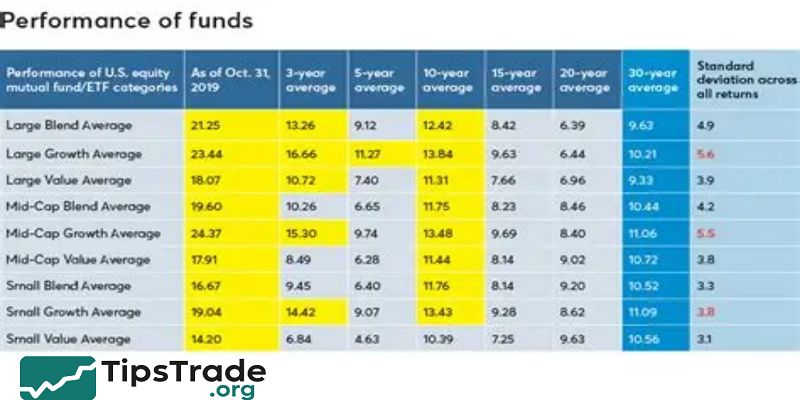
Fund performance metrics include historical returns, CAGR (Compound Annual Growth Rate), and comparison against benchmarks such as the S&P 500 or sector indices.
Tips:
- Evaluate performance over multiple timeframes: 1-year, 3-year, 5-year, and since inception.
- Compare fund returns with benchmark performance to assess fund manager effectiveness.
- Use rolling returns to smooth volatility and observe consistency.
Example:
- A balanced fund returning 7% annually over 5 years versus its benchmark at 6% shows slight outperformance, but the investor should also consider risk-adjusted returns.
Expense Ratio and Fees
Expense ratio includes management fees, administrative costs, and marketing expenses. Lower fees directly enhance net returns.
Bullet Points – Key Considerations:
- Expense ratio <1% is generally favorable for long-term investors.
- Check for additional fees such as 12b-1 charges or exit loads.
- Understand how fees affect CAGR over multiple years.
Example:
- A 1% expense ratio on $100,000 invested reduces returns by $1,000 annually, which can compound significantly over a decade.
Portfolio Composition
Reports provide a breakdown of the fund’s holdings, including:
- Top holdings by asset or market value
- Sector allocation
- Geographic exposure (for international funds)
Table Example: Top Holdings of XYZ Fund
| Security | % of Portfolio | Sector | Rating |
| ABC Corp | 8% | Tech | AAA |
| DEF Ltd | 6% | Finance | AA |
| GHI Inc | 5% | Health | AAA |
Importance:
- Helps identify concentration risk
- Enables comparison with benchmarks
- Provides insight into fund manager strategy
Benchmark Comparison
- Benchmark comparison shows how the fund performed relative to a relevant index.
- This helps investors understand whether returns result from skillful management or overall market trends.
Example:
- If a large-cap equity fund gains 10% while the S&P 500 gains 12%, the fund underperforms its benchmark, indicating potential inefficiencies or higher fees impacting net returns.
Riskmetrics
Key risk indicators include:
- Standard Deviation: Measures volatility relative to historical returns.
- Beta: Indicates sensitivity to market movements; beta >1 means higher volatility than the market.
- Sharpe Ratio: Assesses risk-adjusted returns; higher values indicate better returns per unit of risk.
Example:
- A fund with a beta of 0.8 is less volatile than the market, suitable for risk-averse investors, while a Sharpe ratio of 1.2 indicates good risk-adjusted performance.
Fund Manager Details
- Reports often include information about the fund manager’s experience, tenure, and investment style.
- Experienced managers with consistent track records can impact fund performance positively.
Example:
- A fund managed by an expert with 15 years of portfolio management experience and a history of outperforming benchmarks may offer more confidence to investors.

Tips for Analyzing Fund Performance
- Compare funds within the same category to avoid misleading conclusions.
- Consider long-term performance rather than short-term fluctuations.
- Look for consistency across different market cycles.
- Review annual and semi-annual reports for updated portfolio composition.
- Factor in taxation when evaluating net returns
Common Mistakes When Reviewing Fund Reports

- Focusing solely on past returns without considering risk.
- Ignoring fees and expense ratios that reduce net returns.
- Overlooking portfolio concentration or sector biases.
- Comparing funds from different categories (e.g., small-cap vs large-cap).
- Not checking benchmark alignment.
Conclusion
Mutual funds reports provide investors with a comprehensive view of fund performance, risk, fees, and portfolio allocation. By understanding key components, analyzing data carefully, and considering risk-adjusted returns, investors can make informed decisions that align with their financial goals.
See more: