
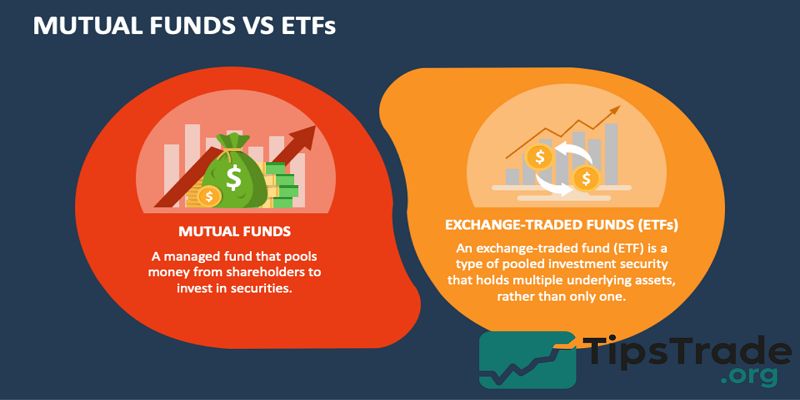
Mutual Funds vs ETFs? Both are pooled investment vehicles that allow individuals to gain exposure to a diversified portfolio of assets, but they differ in structure, trading flexibility, cost, and tax efficiency. According to Morningstar, global mutual fund assets reached $55 trillion in 2023, while ETF assets surpassed $10 trillion, reflecting the growing preference for flexible, low-cost investment options. Understanding these differences helps investors make informed decisions based on goals, risk tolerance, and time horizon. This guide explores the nuances of both investment vehicles, helping investors select the one best suited for their portfolio strategy. Explore the detailed article at tipstrade.org to be more confident when making important trading decisions.
Understanding Mutual Funds and ETFs
What is a Mutual Fund?
A mutual fund is an investment vehicle that pools money from multiple investors to purchase a diversified portfolio of stocks, bonds, or other securities. Managed by professional fund managers, mutual funds aim to achieve specific financial objectives, such as growth, income, or capital preservation.
Investors buy or redeem shares at the end-of-day Net Asset Value (NAV), which reflects the total value of the fund’s holdings divided by the number of shares outstanding.
For example, the Fidelity 500 Index Fund allows investors to gain broad exposure to the U.S. stock market with automatic reinvestment of dividends.
Mutual funds are ideal for individuals seeking professional management and long-term growth without monitoring intraday market fluctuations. They provide simplicity, automatic diversification, and access to a variety of asset classes.
What is an ETF (Exchange-Traded Fund)?
An ETF is similar to a mutual fund in that it pools investor money to create a diversified portfolio, but it trades on stock exchanges like an individual stock. This enables investors to buy and sell shares throughout the trading day at market prices, which can differ slightly from the ETF’s NAV.
ETFs often track an index passively, such as the SPDR S&P 500 ETF, providing low-cost exposure to the market.
They combine the diversification benefits of mutual funds with the liquidity and flexibility of stocks. ETFs can also be used for hedging, tactical allocation, and sector-specific exposure.
Their growing popularity is largely due to lower expense ratios, tax efficiency, and the ability to trade intraday, which appeals to both long-term and short-term investors.
Key Differences Between Mutual Funds and ETFs

Trading and Liquidity
- Mutual funds are bought and sold at the end-of-day NAV, meaning investors execute trades only after the market closes. In contrast, ETFs trade intraday, with prices fluctuating based on supply and demand.
- This flexibility allows investors to capitalize on market movements, place limit orders, or use stop-loss strategies.
- For example, during high volatility, an investor may sell an ETF at a premium to its NAV or wait for a discount.
- While mutual funds offer convenience and stability, ETFs provide real-time liquidity and market responsiveness, making them suitable for both active traders and long-term investors seeking flexibility.
Fees and Expenses
- Fees differ significantly between mutual funds and ETFs. Mutual funds may charge expense ratios, management fees, and sometimes sales loads (front-end or back-end).
- ETFs typically have lower expense ratios and no sales loads, but investors may pay brokerage commissions for buying or selling shares.
- For instance, the Vanguard 500 Index Mutual Fund has an expense ratio of 0.04% with no transaction fee for direct investors, while the equivalent ETF may have a similar expense ratio but incurs a brokerage fee if purchased through a broker.
- Understanding cost structures is crucial, as even small differences can compound over time, affecting long-term returns.
Tax Implications
- Mutual funds distribute capital gains to shareholders annually, which may result in a taxable event even if investors do not sell their shares.
- ETFs employ an in-kind creation/redemption process, allowing them to minimize capital gains distributions and enhance tax efficiency. This makes ETFs particularly appealing for taxable accounts.
- For example, a study by Morningstar found that investors holding index ETFs realized fewer taxable gains compared to similar mutual funds, which can preserve after-tax returns over time.
Minimum Investments and Accessibility
- Mutual funds often require a minimum initial investment, ranging from $500 to $3,000, which can be a barrier for small investors.
- ETFs, on the other hand, can be purchased by a single share, making them accessible to a broader audience.
- This flexibility allows investors with limited capital to build diversified portfolios incrementally.
- Additionally, ETFs trade on standard brokerage accounts, while some mutual funds require direct investment through fund companies.
Pros and Cons of Each Investment Vehicle

Advantages of Mutual Funds
- Professional Management: Fund managers actively select securities aligned with objectives.
- Automatic Dividend Reinvestment: Simplifies compounding and long-term growth.
- Diversification: Access to large, professionally managed portfolios.
- Suitability for Beginners: Minimal trading decisions required.
Example: The Vanguard Wellington Fund, a balanced mutual fund, provides diversified exposure to equities and bonds with professional management, making it suitable for long-term investors seeking steady growth.
Disadvantages of Mutual Funds
- Higher Fees: Active management and load fees may reduce returns.
- Less Trading Flexibility: Cannot trade intraday or use limit orders.
- Potential Capital Gains Distributions: Taxable events even without selling shares.
Advantages of ETFs
- Intraday Trading: Buy or sell shares anytime during market hours.
- Lower Expense Ratios: Passive ETFs typically have minimal fees.
- Tax Efficiency: In-kind redemption limits taxable capital gains.
- Flexibility: Can implement tactical strategies and hedge portfolios.
Example: SPDR S&P 500 ETF (SPY) allows investors to trade fractional shares intraday while tracking the S&P 500 at low cost.
Disadvantages of ETFs
- Brokerage Commissions: Can increase costs for frequent trading.
- Bid-Ask Spread: Small difference between buying and selling price may affect returns.
- Less Automatic Management: Investors must manage rebalancing and dividends.
How to Choose Between Mutual Funds vs ETFs

Investment Goals and Horizon
- Long-term investors seeking professional management may prefer mutual funds, while ETFs suit both long-term passive strategies and short-term trading.
- Assess whether the objective is capital growth, income, or tactical allocation to determine the appropriate vehicle.
Risk Tolerance and Diversification
- Both vehicles offer diversification, but ETFs provide the ability to target specific sectors, regions, or asset classes.
- Investors with higher risk tolerance may prefer ETFs for tactical trading, while conservative investors may benefit from mutual funds’ stability.
Cost Considerations and Tax Efficiency
- Compare expense ratios, load fees, and brokerage costs. Taxable accounts may benefit from ETFs’ tax efficiency.
- Mutual funds may be better for retirement accounts with tax-deferred growth, where capital gains distributions have less impact.
Conclusion
Both mutual funds and ETFs provide diversified investment options. Mutual funds offer professional management, simplicity, and automatic reinvestment, ideal for long-term investors. ETFs provide lower costs, intraday trading, and tax efficiency, suitable for active investors or those with taxable accounts. Investors should evaluate goals, risk tolerance, fees, and tax considerations when deciding between these vehicles.